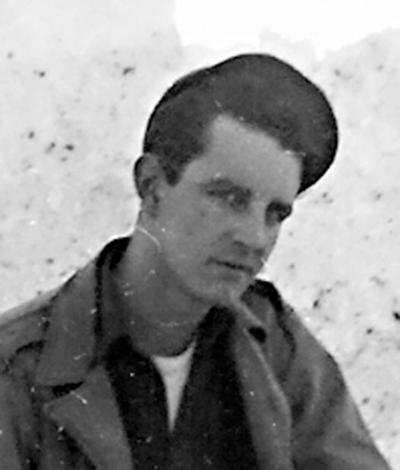

ALTAMONT — In Jim Bishop’s book “The Day Kennedy Was Shot,” Edwin Bates Stroble from Altamont is identified as a member of the embalming team for President John F. Kennedy.
The book reports that Gawler’s Funeral Home in Washington, D.C., had a team waiting for Kennedy’s body that included Stroble, John Van Haesen and Thomas Robinson.
According to Lynn Kull, who owns Kull Funeral Homes in Altamont and St. Elmo, Stroble was the lead embalmer. He was trained by Kull’s father, Woodrow A. Kull, who established the funeral business in December 1936.
“After serving his apprenticeship, Stroble left Altamont in a few years and worked in different locations,” Lynn Kull said. The son of Edwin and Gladys Stroble, Edwin Stroble was born May 22, 1921, in Altamont and died May 29, 1976, in Riverdale, Md.”
Kull grew up in the funeral part of the family business and quickly learned about embalming. He remembers talking with Stroble while Stroble was visiting his mother in Altamont during the Christmas holidays in 1963, shortly after the Kennedy assassination.
People are also reading…
“Look what I have, a check for $100 for embalming the president,” Stroble told Kull. “He told me he was displeased about the nonviewing of the body, a letdown for an embalmer who works to get a body viewable. He said President Kennedy was shot in the very top of the cranium and was hit about the seventh vertebrae in his back. Kennedy’s face was not marred. I should have had a tape recorder to record this information. No one had a tape recorder at that time.
“Stroble told me that when he was embalming President Kennedy there were military officers in the room. He told them in so many words to ‘get the hell out.’”
Stroble also mentioned that the Kennedy casket handles had been pulled out. The copper casket went to the basement and Kennedy was placed in a solid mahogany casket for the funeral.
“Years later, approximately two or three months before Stroble’s death, I wrote the Harvard Law School or some Eastern law school which was offering a course on the Kennedy assassination,” Kull continued. “I had happened to see this in the Parade magazine in the Decatur Herald & Review.
“I mentioned that I knew the embalmer of Kennedy’s body and this source of information could put to rest the controversy of how many bullets, etc.
“I did not mention Stroble’s name because of the mysterious deaths surrounding the assassination. I never heard from the school and Stroble died of a stroke while his automobile was packed to travel from Maryland to Altamont over the Memorial Day weekend. The fellows he worked with forced entry to his apartment after seeing his packed car. Stroble lived one day after being found, very strange situation,” Kull said.
About the $100 check, Kull said he has never been able to get a copy of the canceled check.
“I believe this was with his belongings that were disposed of in Maryland. On Nov. 18, 1982, I called Gawler’s Funeral Home about the check. Gawler’s has been sold to a corporate firm which had their records in Houston, Texas. I wrote and called them. They said they had no record of the check,” Kull said.
Further evidence of Kull’s story is found in a 1964 letter from Stroble to Linda Grobengieser (now Frederick), a daughter of Delbert Grobengieser, who worked part time in the funeral home. Linda also helped out in the funeral home.
“In 1964 I was home from college and discussed the Kennedy situation with Linda,” Kull remembers. “I told her about the check and said, if you don’t believe me why don’t you write Stroble and ask him yourself? She knew Stroble because of being around the funeral home.”
Linda wrote Stroble and received a reply which said in part:
“I was simply astounded that you had ever heard about my being the one to embalm Pres. Kennedy, or rather to put him back together. I’m under orders from the White House, Secret Service and the FBI not to discuss any factors relating to points of entry of bullets, nor their effects. So I can’t tell you anything that would be interesting evolving from natural curiosity.
“I can, however, tell you that it took all my knowledge and acquired skills to make him presentable. That along with a lot of good luck. The good luck part, only an embalmer would understand. The rest I owe in a great measure to one of the best embalmers I’ve ever watched. He’s the same guy you mixed fluid for. He taught me well.
“Two very important parts of a good embalming operation: How to pose features naturally and how to use a horse sense flair for makeup.
“I was very pleased with my end result and did hope everyone would be able to see him. But Jackie decreed otherwise. She and his brother saw him when we put him in the East Room. Later the White House staff also saw him but she said close it and that was that. I was very disappointed to say the least. But as things turned out, it was a wise decision on her part.
“Through those 3½ days there was a very high emotional response from the people of the district and, for that matter, the whole East Coast and if the casket had been open, I’m sure that it would have been mass hysteria.
“So someone whom I had more or less considered a cute gal hanging on to high and mighty coattails made a very wise decision, In fact, she was tremendous throughout the whole deal.
“Enough of that.”
Clint Hill signed a copy of the letter when he was in Altamont in October. Hill was the Secret Service guardian of Jackie Kennedy and, along with Lisa McCubbin, is the author of two books about the assassination.
bfallstrom@herald-review.com|(217) 421-7981