
Hometown: USA. I grew up in Northern Virginia, moved to Los Angeles for five years, and finished my college years in Fort Myers, Fla. I am now a farm girl in Blue Mound.
Family: My husband, Blake, and two puppies.
Occupation: Case manager for Big Brothers Big Sisters
Education: I graduated from Florida Gulf Coast University in Fort Myers with a bachelor’s degree in psychology. I am continuing with graduate studies at the University of Illinois at Springfield in human resources.
My “I’d rather be …” bumper sticker would read: “I’d rather be traveling.” I am blessed to have parents on both coasts and siblings scattered throughout the United States. Visiting my family has all the perks of a vacation and the feeling of being home.
Hobbies/interests: I enjoy outdoor activities from gardening to horseback riding, and everything in between. Cooking has always been a passion of mine. I try to cook from scratch and put my own spin on recipes, which can create interesting conversations at the dinner table. My husband doesn’t seem to mind my kitchen creativity.
People are also reading…
My first job: At age 13, I worked for a park that offered catered events. I started my first job as a high-ranking parks and recreation custodial engineer. In other words, I started off cleaning bathrooms and picking up trash. After mastering the custodial studies, I was promoted to onion chopper. Thinking of that job still makes me tear up.
Why I do what I do: During my first year as a case manager, it’s been fun to watch “matches” I’ve introduced move from the “friends” category and closer to “family.” I have been surprised by how much the child has impacted the volunteer in many cases. Those types of success stories are why I do what I do.
Personal approaches to challenges: I am a firm believer in prayer and a good night’s rest.
Community involvement: I’m a volunteer mentor in the Big Brothers Big Sisters organization (along with Blake, who is a Big Brother — together with our Little Brother we are a “couples match”). I will be starting my first year on the St. Mary’s Advisory Council. I also have served dinners at the Blue Mound Fall Festival.
Tell us a little about Big Brothers Big Sisters? It’s a small-time commitment for our volunteers, but that time can be a VERY big deal for the kids in our program. Each mentor determines his or her own schedule, as long as it’s on a consistent basis for at least one year’s time. For some Bigs, it’s just an hour or so per week. Others like to get together for several hours on a weekend. We offer two matching options — school-based consists of meeting with a student one lunchtime per week at school (which is something a lot of our professional volunteers build in as part of their work week); the community-based format allows a mentor to do activities with a child Little 2 to 4 times a month for activities away from school. We do special trips, cookouts and agency events in addition to whatever the match wants to do independently. A lot of them like to go to the library, the movies, cook together, stuff like that.
Why is the organization so important? Our program provides children with a number of risk factors with a safe structure to meet positive role models. Providing children in need with the opportunity to gain new perspectives and discover new possibilities, we think it’s impossible to quantify the good that can do. Our organization has been around since 1904. In that time, the service-delivery model has become so refined that we can often predict the improvements kids will make behaviorally and academically. Studies have shown that kids who have a mentor providing social and emotional support do much better long term than kids who get tutoring alone. Our outcomes demonstrate that children become much more likely to avoid involvement in the juvenile justice system, and much more likely to graduate from high school. In turn, these kids become an asset to the community rather than a liability.
How do kids come into the program? Is there a waiting list? Children are referred to us in a variety of ways. Parents or caregivers often know about us through family or friends, and can apply directly to enroll their children in the program. Our services are totally free for all families and volunteers. We also receive referrals from churches, schools and other youth organizations. Yes, there is a pretty consistent waiting list, because parents understand the value and are willing to be patient while we find the right adult to work with their child. We currently have 71 kids waiting. In Decatur, we have a particularly tough time (compared to our other counties) recruiting men to become Big Brothers.
How do you match me with a Little Brother or Sister? We are obviously very careful about screening in safe, reliable volunteers. But our enrollment process is straightforward and begins with an interview where we have a chance to get a feel for your personality and your preferences for the pairing we make. Our goal is to put every volunteer into a match where they have the best chance of forming a solid friendship. After we complete our background checks and references, we identify a child from the waiting list with whom we think you will do well. Then we talk about that candidate and give you information about their background. If you think the situation is one in which you’ll be comfortable, we work with the family to set up the first meeting. Your caseworker facilitates everything.
What is expected of the Big Brother or Sister? Consistency. Reliability. Lending a nonjudgmental ear. And a willingness to revert back to being a kid again!
How did you become involved with the organization? Shortly after moving to the area, I heard there was an opening and felt like the position would be a good fit. After working closely within the organization, Blake and I recognized the definite need for as many Decatur volunteers as we can find. One of the kids in our program lost his Big Brother, and his grades and behavior got worse almost immediately. His personality has been a great fit for Blake and for me. He’s shy but comfortable with the two of us. Now we’re getting him to socialize more out in public.
What is your pitch to those who are on the fence about becoming a Big Brother or Sister? If you have a lunch hour, then you have the power to improve a kid’s life. It may sound corny but it’s true. Our school-based option makes it possible for virtually anybody to volunteer as a mentor.
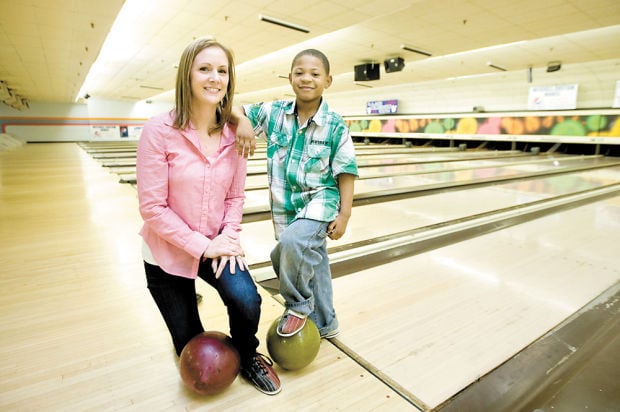
For those who can’t commit to being a Big Brother or Sister, are there other ways they can get involved? We have a lot of avenues for involvement, namely on our Regional Advisory Board (which puts on our fundraisers each year. We receive no state or federal funding. All of our support comes to us because people choose to support our program and its results). The simplest way to contribute is to attend our events. We do a fun Night in the Islands party in November at The Decatur Club. Coming up we have our biggest annual event, Bowl for Kids’ Sake. It’s March 15, 16 and 17. It’s filling up, but you can still register a team at bbbs.kintera.org/2013. We get business teams, family teams, youth groups. People who do it once come back year after year, it seems.
It appears you’ve lived all over the place. How did you come to be in Central Illinois? If you ask my husband, he will claim he flexed on the beach in Florida and that’s all it took. Ha. Truth be told, I visited the area several times while dating my husband, and fell in love with the small-town atmosphere. I love supporting a Midwestern way of life and their traditions. It is easy to get lost in the hustle and bustle of a large city.
What are your initial impressions of the area? What do we do that you like? Where do you think we need to improve? In my initial impression, I thought Decatur had a unique aroma and a lot of auto parts stores. Every main road had an AutoZone or an O’Reilly’s. Now that I’ve been here longer, I like the traditional small-town sense of community. There is a passion for acceptance, and always a friendly face. The commute from Blue Mound to Decatur is a lot more relaxing than Los Angeles’s 90 mph bumper-to-bumper traffic. I think Decatur is on the right track with the downtown improvements. I would like to see more restaurants with outdoor seating during the warm months.