


Undergraduate students at Illinois State University do not have to wait years to begin research, and for James Aygun, who graduated in May with a bachelor’s degree in physics, that early access has led to grants, publications, and a future in the field of physics.
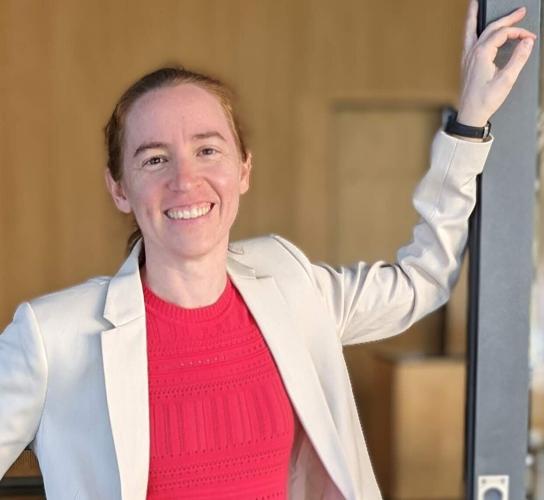
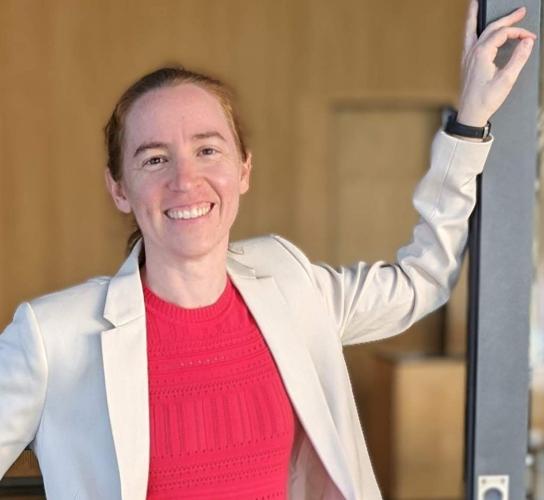
During his sophomore year in a Methods of Theoretical Physics class, Aygun met University Professor of physics Allison Harris, who recognized his quiet determination and strong work ethic. Harris invited Aygun to join her research group, an opportunity that helped launch his academic career.
“It was very clear that he knew what he was doing, and he was very good at solving problems in class,” Harris said.
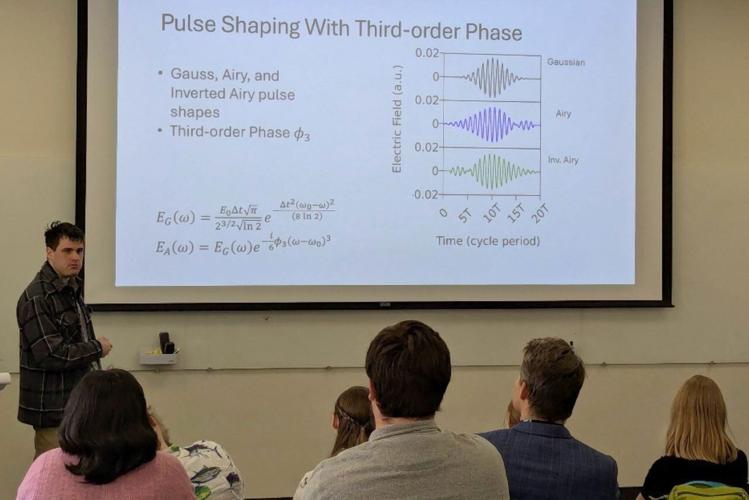
Since 2023, Aygun has been working with Harris on multiple computational projects in atomic physics, focusing on how atoms behave under intense lasers.
People are also reading…
“If you shine a really bright light, a laser, at an atom or molecule, we’re interested in what the interaction between the light and the atom is,” Harris said. “James has looked at a couple of different processes that happen once the electron leaves and when it cycles back.”
His resulting research, “Asymmetry in Molecular Attosecond Energy Streaking using Sculpted Laser Pulses,” was funded in part by a 2024 grant through Faculty-mentored Independent Research Experiences (FIREbird). Awarded by Illinois State’s Office of Student Research, FIREbird research grants provide undergraduate students with funds to cover student hourly wages, research incentives, supplies, or travel.
“ISU and Dr. Harris have given me a lot of really good research experience,” Aygun said. “One of the great things about this (physics) program is it’s very open to undergraduate research, and there are a lot of opportunities to get involved.”
Harris said on-campus grants and funding like the FIREbird awards are essential to student research experiences.
“Our students are all very busy but getting them involved in research is something that really allows them to grow as scientists. Grant funding is really critical for supporting students. It’s critical for supporting science in general,” Harris said. “Those discoveries oftentimes lead to really important breakthroughs in technology or in medicine.”
In 2024, Aygun and Harris co-authored a research paper published in The European Physical Journal D, “Spectral Phase Pulse Shaping Reduces Ground State Depletion in High Order Harmonic Generation.”
Aygun helped discover that by altering the shape of laser pulses interacting with atoms, certain methods are gentler on the atom and do not strip away as many electrons in the process. This area of research contributes to the fundamental understanding of physics and chemistry and can be useful for designing more efficient electronics.
Aygun recently expanded his work to include observation of molecules as well as atoms, developing a new technique to streamline the process. He said the computing and coding skills formed at Illinois State were key to beginning his next journey in the physics doctoral program at Purdue University.
“One of the great things about this (physics) program is it’s very open to undergraduate research, and there are a lot of opportunities to get involved.”
—James Aygun ’26
He encourages undergraduate students to be limitless in their curiosity and exploration.
“Get involved in research as soon as possible,” Aygun said. “ISU is a really good place to start research very early.”
Harris added that persistence matters just as much as curiosity.
“Most of the time that you spend as a scientist is actually trying to troubleshoot things, and in some ways, maybe doing the wrong thing before you find the right thing,” Harris said. “You have to be willing to stick with it, and eventually you solve those problems, but they’re not easy because you’re doing something that no one else has ever done before.”
Aygun’s efforts will impact Redbird researchers long after he graduates. Harris plans to work with future students, using the framework built by Aygun, to examine a variety of molecules to determine whether electron ionization time is universal or dependent on molecule structure.
Applications are open for fall 2026 and spring 2027 FIREbird Grants for undergraduate student research. Visit StudentResearch.IllinoisState.edu/Funding to learn more.


