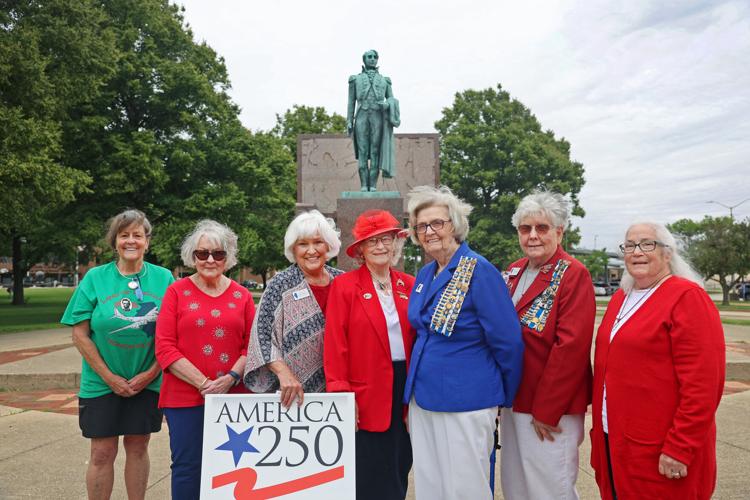

Members of the Stephen Decatur Chapter of the Daughters of the American Revolution Debbie Slayton-Czerwinski, Thelma Martin, Janice Parsons, Virginia Rinehart, Ann Perisho Irwin, Cheri Hunter, and Sy McElvain pose in front of the Stephen Decatur Monument in Decatur on May 21.
DECATUR — In 1829 the pioneers who established Macon County sought to hitch the name of their new county seat to a shining star, and they chose Commodore Stephen Decatur.
For those hardy souls of yesteryear, naming their new city “Decatur” in salute to such a brave and courageous man was really a no-brainer.
The U.S. Navy hero had been killed some nine years previously but his name was firmly moored in the hearts of his countrymen. It was Decatur who had given the then British superpower’s Royal Navy a black eye in the war of 1812 in defense of the new-born American nation. And he had found even more glory teaching pirates a painful lesson in the First Barbary War of 1801, and then did it again in the Second Barbary War of 1815.
Himself the son of a Revolutionary War naval hero — Capt. Stephen Decatur Sr. — the dashing family scion was sleek, dark and handsome, with Elvis-like sideburns and a glint in his eye; his derring-do on the high seas had been feted nationwide with parades, songs, poems and gifts.
People are also reading…
Over the years he would morph into five counties and 17 towns and cities named for him (our Central Illinois Decatur remains the largest), and five U.S. Navy ships, the first being a sloop-of-war in 1839 and the latest a guided missile destroyer commissioned in 1998.
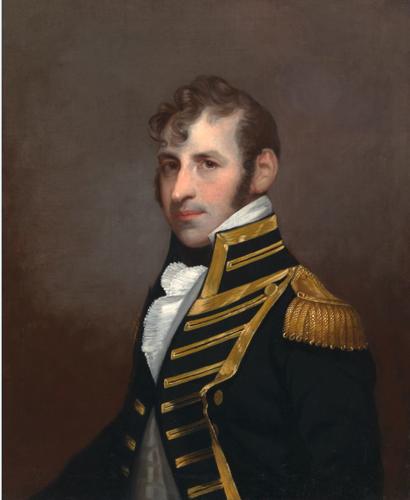
U.S. Navy officer Stephen Decatur, the namesake of Decatur, Illinois, is depicted in this oil painting by Gilbert Stuart and Charles Bird King.
Now, as the country gears-up to celebrate its 250th birthday, it feels as good a time as any to take a closer look at the city of Decatur’s namesake. And there are no better guides than the patriotic women of the Stephen Decatur Chapter National Society Daughters of the American Revolution.
THE DAR
First a bit of background on the Decatur DAR chapter. They have more than 100 members on the rolls and, to become one, you have to establish your genealogical link to a man or woman caught up in the Revolution “who, with unfailing loyalty to the cause of American Independence, served as a sailor, or as soldier or civil officer in one of the several Colonies or States, or in the United Colonies or States, or as a recognized patriot, or rendered material aid thereto,” to put it in the exacting phraseology of the DAR’s National Society, its ruling body in Washington, D.C.
Navigating that kind of DNA labyrinth that far back is not always easy. But the accommodating women of the Stephen Decatur chapter stand ready, willing and able to assist you from their extensive collection of records housed within the new and pristine headquarters of the Decatur & Macon County Genealogical Society and Library.
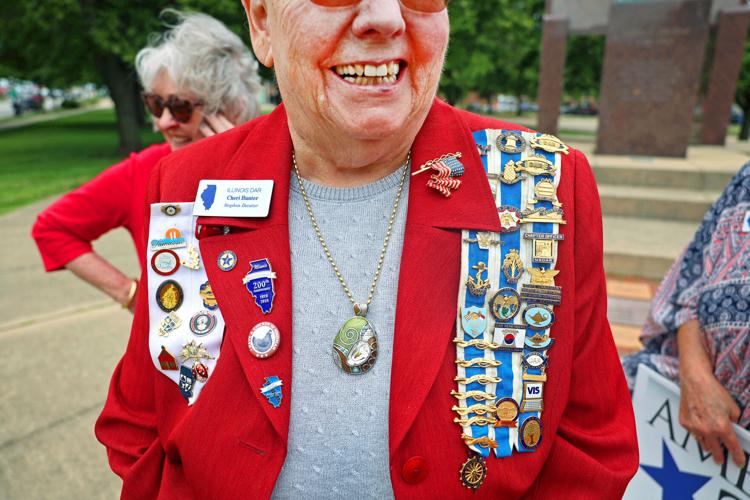
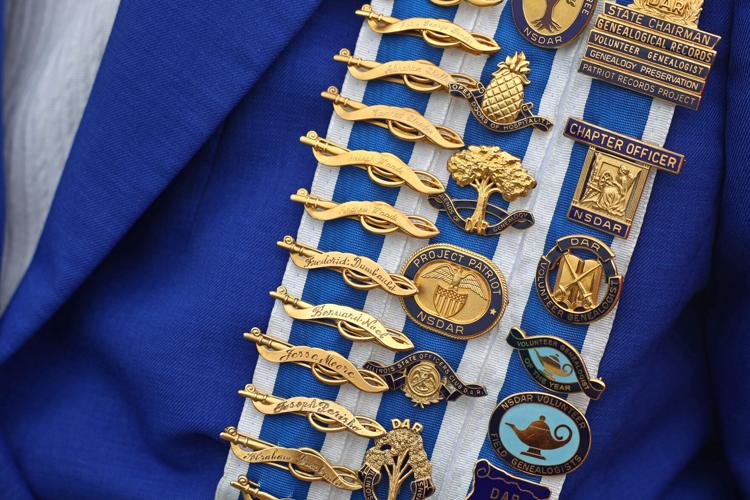
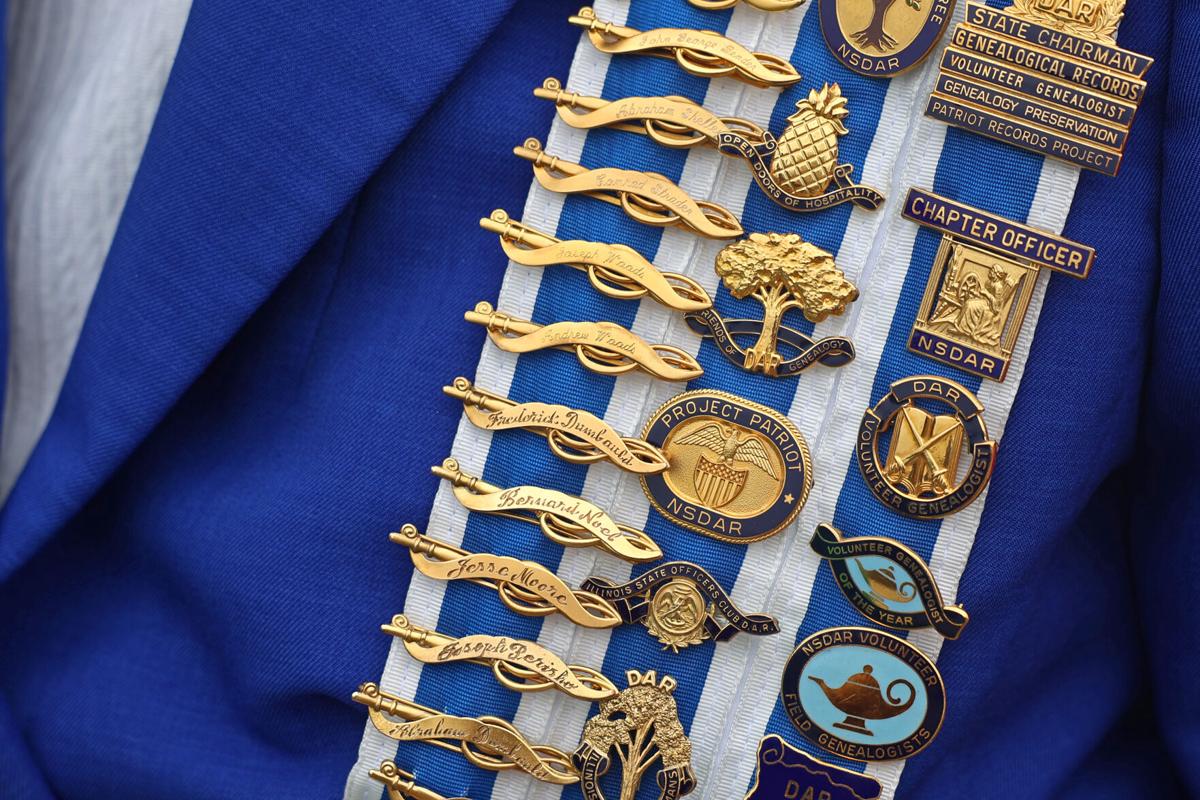
Cheri Hunter sports her pins with the Stephen Decatur Chapter of the Daughters of the American Revolution in Decatur on May 21.
And the local chapter could use a shot of fresh, enthusiastic blood, as the average membership age is 70-plus. “Yes, we have many members, but we don’t have very many active ones,” laments Janice Parsons, 78, who serves as the Decatur chapter’s Regent, which is their top banana.
And talking of top bananas, the conversation with Parsons quickly reverts back to Stephen Decatur, why he matters, and why we should remember him in the runup to this most auspicious of July 4 celebrations.
“He was a very, very popular figure,” said Parsons.
“And if he hadn’t gotten into that duel with that guy, he probably would have been president at some time. He was kind of a big deal.”
Tragic irony
Ah, the duel. It is perhaps the most ironic of tragic ironies that the 41-year-old man who survived enemy musketry, cannon balls and cutlass slashes on the high seas wound up getting blown away in a country field not far from his Washington, D.C. townhouse; and he was even killed by a fellow naval officer.
The young Decatur had earlier served on a court martial jury that saw Commodore James Barron suspended from his naval duties for negligence. And Decatur had publicly spoken out against the defendant when he tried to reenlist. An angry and bitter Barron, in the illegal but tolerated custom of the time, demanded “satisfaction” by challenging our war hero to a duel. It was arranged they would settle the matter with flintlock pistols at 9 a.m. on March 22, 1820.
They stood facing each other just 24 feet apart in a spot so often used for duels it had the nickname “The Valley of Chance.” The combatants took aim and, under the peculiar rules of the duel, had to open fire within a count of “one, two, three,” but not before “one” and not after “three.”
Witnesses said both men pulled the trigger after the count of “one” and each instantly fell, wounded. Barron would pull through and survive but Decatur, hit in the pelvic area with arterial damage, was doomed; he was carried home and died after enduring 12 hours of searing agony.
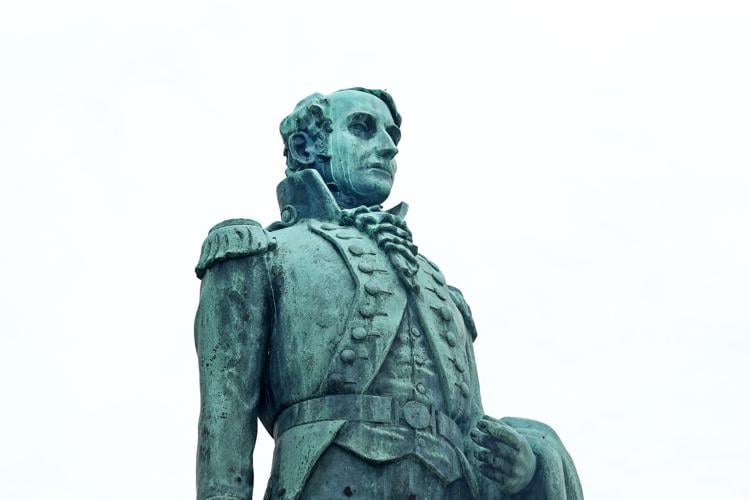
The Stephen Decatur Monument stands over the corner of East William and North Franklin Street in Decatur on May 21.
“Dueling,” laments Parsons the regent. “That was kind of unfortunate; I would not have wanted to be a ‘gentleman’ back then.”
And, for a while, the wasteful manner of his demise darkened the naval hero’s reputation, especially as the man himself had spoken out against dueling and tried to discourage it among his junior officers. Believe it or not, historians have estimated that the U.S. Navy lost more officers to dueling than enemy combat between the years 1798 to 1848.
History expert Matthew Goetz, senior historian, Marlyne Sexton chair in White House History with the White House Historical Association, writes that Congress suddenly got all righteous now that Stephen Decatur had sunk beneath the ground. The politicians repeatedly refused to pay his pretty but cash-strapped widow Susan Decatur money she claimed she was owed as reward for her husband’s military service.
Goetz also notes that newspapers, until then always Decatur’s unified hallelujah chorus, sounded some distinctly discordant notes in the wake of his death: “He fell like a fool and died as a fool dieth,” in the charming words of one literary diatribe.
Hallowed memory
But like a navy ship battling through a storm, Decatur’s name and reputation quickly began to right itself and would soon find safe anchorage once more in the blessed harbor of hallowed memory. “Decatur Dies! But his…peerless name… shall live… till winds no more shall rage, nor billow roar, and Freedom’s Sun shall set to rise no more!” gushed a New England paper only two months after Decatur had stopped that duelist’s bullet.
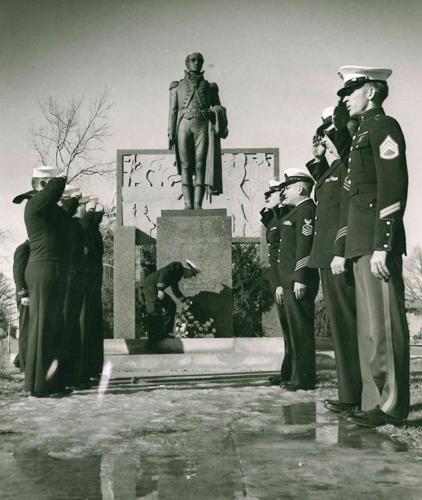
1961: Decatur citizens were urged to adopt the example of Commodore Stephen Decatur in a ceremony commemorating the 181st anniversary of the Naval hero's birthday. Sailors placed a wreath on his statue located near the Civil Center in Decatur.

“And the people who founded Decatur not only still admired him, they might have known him,” said Virginia Franklin, 81, treasurer of the Decatur DAR chapter, noting many pioneers had trekked west from Stephen Decatur’s old stomping grounds out east.
“That is possible,” added Cheri Hunter, 90, an honorary regent with the chapter. “Despite everything, Stephen Decatur was still the big hero of the War of 1812 and of Tripoli and the pirates.”
In that war of 1812, fought against British attempts to bully the new nation, Decatur had achieved national fame when he out-maneuvered, outgunned and captured the British warship Macedonian, a feat that stunned the Royal Navy.
Pirates operating from the coast of North Africa, meanwhile, were harassing and capturing American shipping, demanding tribute payments and enslaving or ransoming back their crews.
In 1804 Decatur led a daring raid of U.S. Marines in Tripoli harbor that fought hand-to-hand with the pirates and burned the captured USS Philadelphia, denying the enemy their prize.
That line in the Marines Hymn “to the shores of Tripoli, we fight our country’s battles in the air, on land and sea,” refers to the Decatur raid and subsequent military actions. Britain’s foremost Naval hero, Admiral Horatio Nelson, had described Stephen Decatur’s fearless attack as “the most bold and daring act of the age.”
In this 2012 file photo, Jerry Johnson, stands in front of the Stephen Decatur mural he painted downtown. The work marked the beginning of the Decatur Mural Project.
Following the war of 1812, Decatur was back off the African coast fighting the pirates again in 1815. This time he sailed into Algiers harbor and forced the bad guys to sign a treaty saying they would leave all American ships alone, release all prisoners and even pay compensation.
Admired
“Yes, Decatur’s name would have been on people’s minds when the city of Decatur was founded,” said Hunter. “He was a dashing person and people just admired him.”
One of the missions of the Decatur DAR chapter is to make sure we remember our fallen heroes, and to promote patriotism generally in service of country. The chapter was established on Feb. 4, 1896, and meets once a month with guest speakers on various historical topics. And it has always stayed busy, blending a love of the past with a sense of caring for the present and future.
In World War I its members helped purchase an ambulance for the War Department and made surgical dressings and hospital garments for the Red Cross. In World War II they again helped the Red Cross with occupational therapy, donating blood and working as nurses’ aides.
These days the chapter donates to support everything from the teaching of history in schools to funding nursing scholarships. It stages a competitive event every year to promote good citizenship among high school students in Macon County, open to both regular classroom and home-schooled kids.
And, among many other things, it works to help multiple veterans’ homes in Illinois by raising money used to buy little extras and comforts for the residents.
And so for these women who might well bleed in red, white and blue, it can be a little disconcerting sometimes to discover later generations who don’t share their enduring sense of pride, pomp and circumstance in the most powerful nation to arise in the history of mankind.
“I’m not sure the average younger American could pass a test on the Constitution,” said Hunter, who embraces patriotism as a celebration of who we are; she says the remembrance of the roles played by heroes like Commodore Decatur in nurturing and protecting our democratic way of life remains vital as the American experiment sails into the future.
“If you don’t keep it alive, it’s gonna end,” she predicted.
That all being said, however, the DAR membership believes their nation’s trademark sense of optimism still has reasons to be cheerful as we all wish ourselves many happy returns in this special birthday year.
“Now we are running into a few interesting kids in the schools,” said Franklin the DAR treasurer, talking of encounters with students already hallmarked with a profound sense of purpose that gives the women faith in our collective future. “I think those kids will make the difference.”
From the archives: A look back at Memorial Day in Decatur
Conduct Memorial Service for Sailors
Ran in the Herald & Review on Tuesday, May 30, 1944.
Veterans groups participated in Memorial Day services
Ran in the Herald & Review on Tuesday, May 28, 1985.
Decatur Observes Memorial Day
Ran in the Herald & Review on Tuesday, June 1, 1971.
Memorial Day Centennial
Ran in the Herald & Review on Sunday, May 29, 1966.
Calendar: Memorial Day
Ran in the Herald & Review on Thursday, May 22, 2008.
Honoring our veterans
Ran in the Herald & Review on Tuesday, May 29, 2012.
Memorial Day
Ran in the Herald & Review on Monday, May 25, 1987.
Honoring a fallen friend
Ran in the Herald & Review on Monday, May 26, 1986.
Among Memorial Day Highlights
Ran in the Herald & Review on Thursday, May 31, 1951.
Mark your calendar
Ran in the Herald & Review on Thursday, May 26, 2005.
The parade into Greenwood Cemetery
Ran in the Herald & Review on Sunday, May 29, 1932.
Is the significance of Memorial Day lost?
Ran in the Herald & Review on Saturday, May 27, 1978.
Unknown Soldier Honored
Ran in the Herald & Review on Wednesday, May 31, 1950.
A Time To Remember
Ran in the Herald & Review on Monday, May 29, 2017.
Taking time for honor
Ran in the Herald & Review on Sunday, May 26, 1984.
Decatur Catholics commemorate Memorial Day
Ran in the Herald & Review on Thursday, May 31, 1951.
On Memorial Day weekend
Ran in the Herald & Review on Sunday, May 29, 1988.