


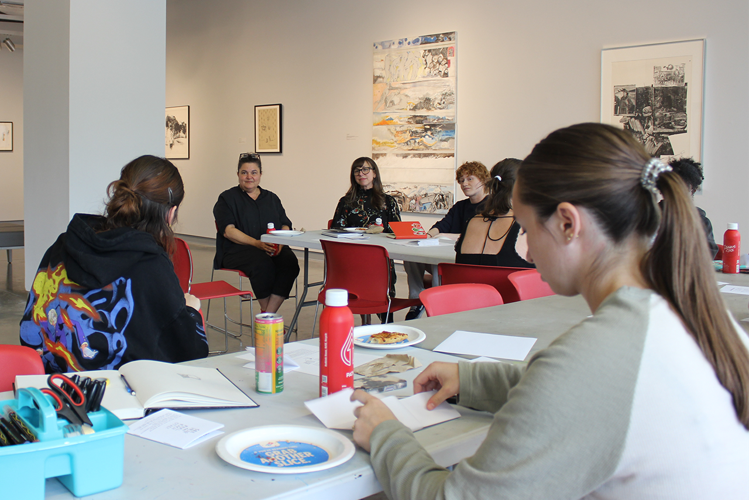
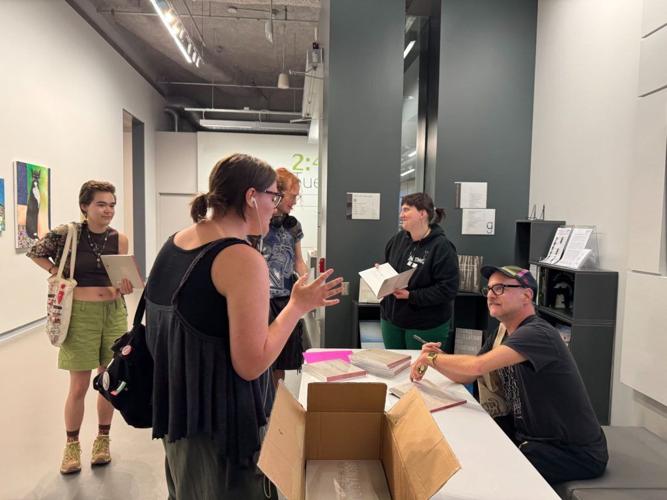
One afternoon last month, a group of Illinois State students sat around folding tables chatting over pizza. The scene was not unusual for a college campus, but the setting was: They were in the middle of an exhibition of University Galleries’ permanent collection, as works by Robert Rauschenberg and other renowned artists hung in the background.
The students were gathered for the latest edition of Creative Practice Lab (CPL), a free program launched in January that has received support from the Lori Baum and Aaron Henkelman University Galleries Community Fund and a Wonsook Kim College of Fine Arts Student Investment Project grant. The monthly meetings feature fine arts-related professional development and offer students the opportunity to discuss art with their peers over a meal and participate in casual Q&As with visiting artists, faculty, and staff.
People are also reading…
“(As of mid-October), we have had nine sessions since February,” said University Galleries Director and Chief Curator Kendra Paitz. “We have met with artists. We have learned matting and framing of artworks. We worked on artist statements. We met with faculty members. And we have just started.”
At the aforementioned September session, the students created art zines while asking Chicago-based artist Selina Trepp—whose stop-motion animations filled another of the galleries’ spaces—about her artistic path, improvisation, family, and a dozen topics in between.
Paitz modeled the lab on the galleries’ Teen Art Group, a professional development program for high school students that is now in its ninth year. “We have monthly meetings. We give teenagers a lot of creative agency and the chance to build a supportive cohort. We collectively curate a public exhibition. We take field trips, and I was thinking, ‘Could we do something like that for ISU students?’” Paitz said.
Upcoming Creative Practice Lab sessions
October 28, 6:30 p.m.: Dr. Ashley Waring-Sparks—interim director of the Center for Mathematics, Science, and Technology—will talk about student research funding opportunities like the FIREbird, BirdFEEDER, and Pinion travel grant programs. There will also be discussion about how to apply to the Image of Research Competition, Student Annual, and other exhibition opportunities. Registration link
November 4, 6:30 p.m.: Students can participate in an extended Q&A with Wonsook Kim School of Art and Design alum Schuyler Maehl ’04, head preparator at the Griffin Museum of Science and Industry in Chicago. Registration link
December 2, 6:30 p.m.: For Unfinished Business Night, students can bring a project, paper, or study materials that they need to finish. Food and space to work will be provided. Registration link
Student-driven collaboration
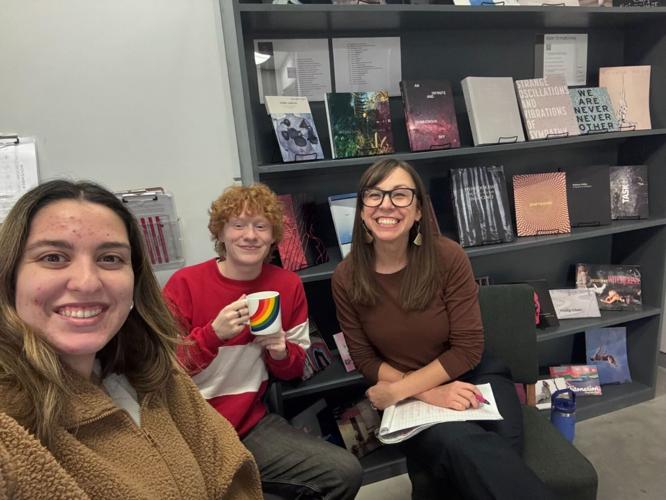
Paitz created the program in collaboration with AJ Westley and Christina Dababneh, Wonsook Kim School of Art and Design students and University Galleries student workers. Westley wanted to give students similar opportunities to what he has gained working at the galleries and also the chance to socialize in person.
“With my generation, it’s hard to connect with people face to face, or know how important networking is, and I feel like that’s really what I wanted to do with this group is to have people coming together, be face to face, and share a meal together, and also get to learn something,” said Westley, a senior arts and art history major from Washington, Illinois.
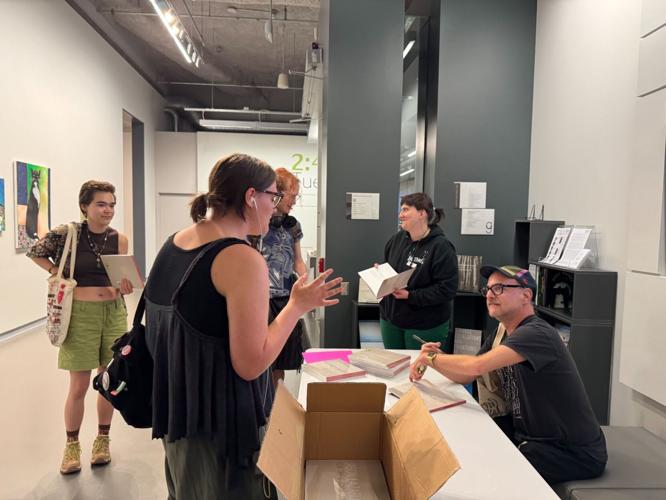
Students have helped develop, organize, promote, and introduce the program. Paitz pointed to Westley’s role in kickstarting the conversation with Florida-based artist, curator, and educator Jason Lazarus earlier this semester.
“We all had tacos and had a really extended Q&A with Jason Lazarus, who had given a public lecture earlier that day in conjunction with our Love Letters exhibition,” Paitz said. “AJ created an activity with prompts, based loosely on Jason’s work, for everybody to go around the table and introduce themselves. And it was incredible and so much more compelling than, ‘My name is, my major is.’ Instead, he was asking people to dig into something from their memory, and people were vulnerable. They were silly. It was a wonderful way of bringing people together and opening them to the conversation.”
The meetings draw between eight and 22 students and are open to all majors. Many students are returning participants, including Maria Kolimbiris, a senior art education major from Schaumburg, who has attended most of the sessions since the lab’s inception.
“I’m mostly a listener because I really enjoy the questions that my peers ask the artists,” Kolimbiris said. “So while we’re sitting around the table and eating our dinner, asking questions, having just good conversation, it’s a way for me, as a young artist and a future educator, to learn about how these people are living their lives.
“I’ve met a bunch of different people at these CPL meetings who are in my cohort as well who I didn’t even know.”
Westley’s goal is to create an enlightening and welcoming environment through which connections can be made.
“The exposure to these professional artists is super-important, definitely,” Westley said. “But I think the most important part that I’m most hoping to foster is a relationship between everyone, and hopefully they learn something along the way.”


