


The Chicago River has a reputation.
Up until the 19th century, the 156 miles of steel-lined canals branching through the city served as a dumping ground for industrial waste and sewage. The memory of that pollution runs deep.
“Every time we do a project, especially down on the South Branch, somebody’s like, ‘Am I going to get sick if I touch the water?’ or ‘Whoa, this place was so gross 10 years ago,’” said Sage Rossman, communications manager of Urban Rivers.
Urban Rivers is a nonprofit environmental group in Chicago that—with help from an interdisciplinary team of Illinois State University researchers in the College of Arts and Sciences—is transforming city rivers into urban sanctuaries by installing green infrastructure while expanding equitable access to nature.
People are also reading…
Dr. Eric Peterson—professor in the Department of Geography, Geology, and the Environment—began working with Urban Rivers Research Director Phil Nicodemus in 2018 to test water chemistry in an area of the Chicago River where the organization installed a modular floating garden.
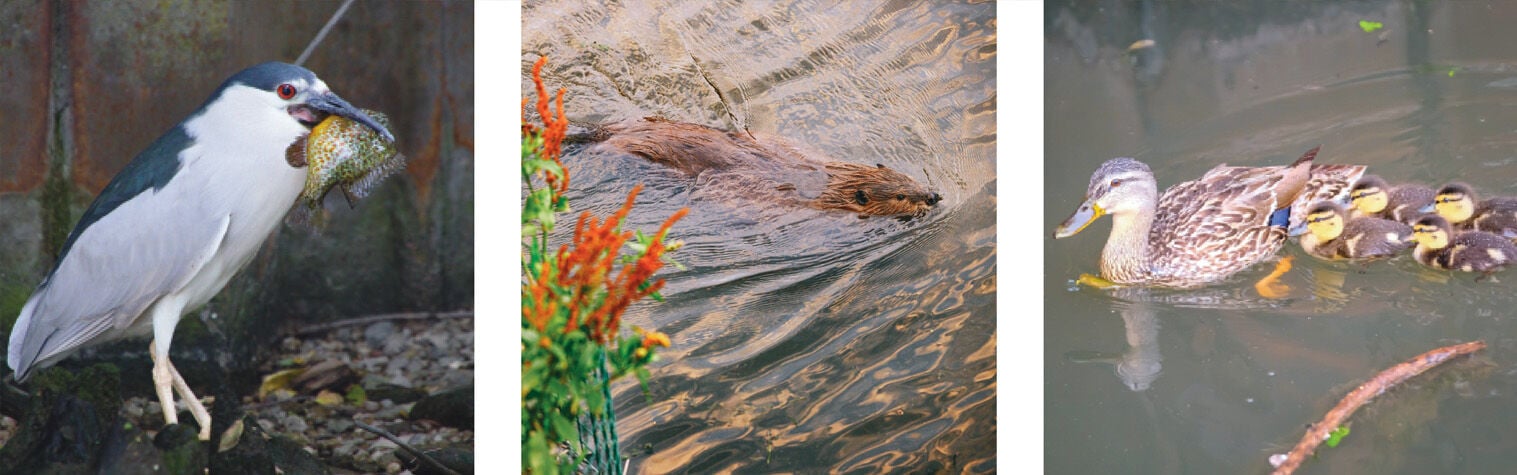
Filled with native wetland plants, the pilot garden was originally installed to expand riverfront habitats. As an added benefit, the root system webbed beneath the floating wetland acts as a filter for river pollutants. Along with Nicodemus and Illinois State graduate students Emmett Spooner, M.S. ’20, and Abigail Heath, M.S. ’21, Peterson co-authored a 2021 study finding the aquatic garden reduced nitrate levels by nearly 7% and phosphate by about 6%, nutrients that, in excess, can trigger algae overgrowth and disrupt ecosystems.
“The wetlands we’re looking at are small compared to the volume of the river, but it still shows that there’s an improvement,” Peterson said.
Peterson then partnered with Dr. Joan Brehm, professor and chair of the Department of Sociology and Anthropology, to co-teach Thirsty Society, a class combining environmental and social sciences to examine water’s role in society.
“We talk about the hydrological cycle as a natural, scientific cycle of how water moves through our environment. But the reality is, humans have the biggest influence on that cycle,” Brehm said. “The choices we make influence equity. Political systems, economic systems, all influence who has access to the water and who doesn’t.”
Inspired by the collaboration, Peterson wondered, “What can we do with Urban Rivers to draw on the social sciences? Who else can we bring in?”
The team expanded to include Dr. Michael Hendricks, associate professor of Politics and Government; Dr. Alec Foster, associate professor in Geography, Geology, and the Environment; Dr. Noha Shawki, professor of Politics and Government; and Dr. Mariela Fernandez, associate professor of recreation, sport, and tourism at the University of Illinois Urbana-Champaign.
The collaboration among the departments is a natural fit, according to the researchers.
“Water is political,” Shawki said.
Supported by a $6,000 College of Arts and Sciences Dean’s Challenge Grant and a $7,500 Illinois State University Advancing Research and Creative Scholarship (ARCS) grant, the team is studying both the environmental impacts of the floating gardens in the Chicago River and how residents engage with Urban Rivers.
Their work spans two Urban Rivers sites, with hydrology research at the Wild Mile garden and social science research near Bubbly Creek.
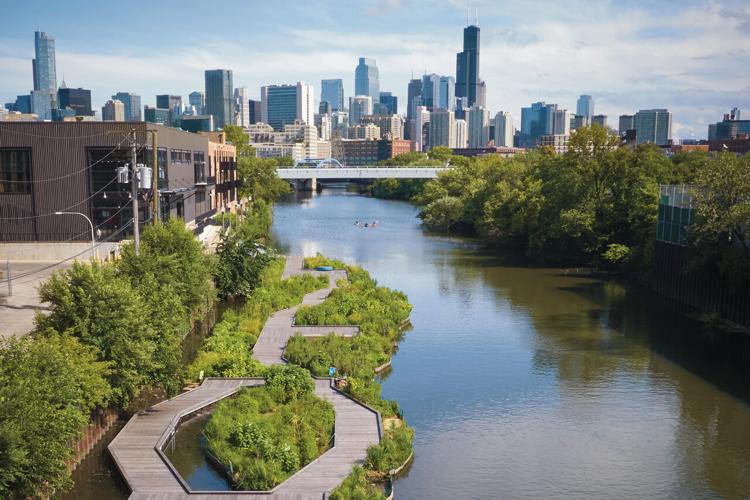
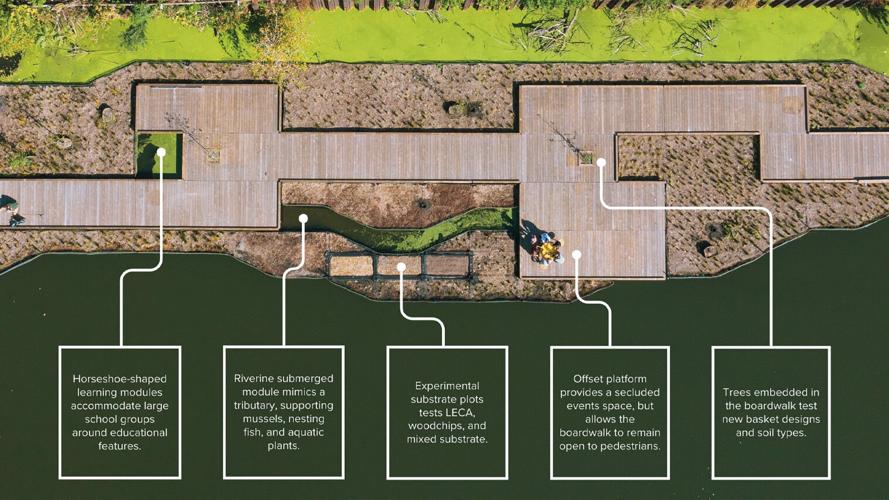
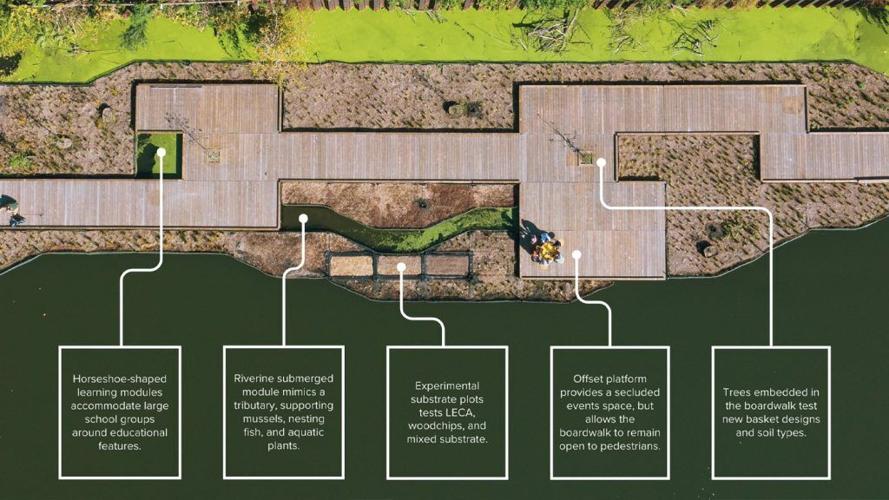
The Wild Mile, along the North Branch Canal, is considered the world’s first floating eco-park. Its current 700-foot-long garden—with plans to eventually stretch a full mile—features a public boardwalk and boat launch. The urban oasis has become a popular spot for field trips, social gatherings, and anyone looking to escape the concrete sprawl.
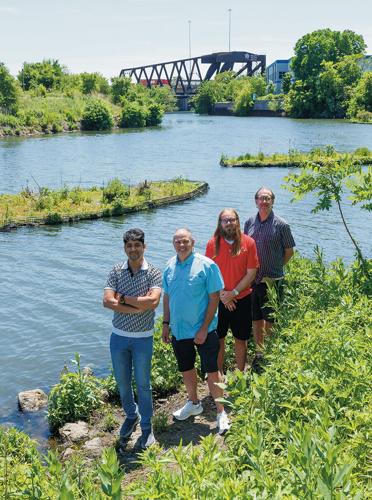
Bubbly Creek, a fork on the South Branch, was once the heart of Chicago’s meatpacking district, its waters so choked with industry waste that Upton Sinclair used the location as an example of environmental neglect in his novel “The Jungle.” Determined to revitalize the area and provide green space for the historically marginalized neighborhoods nearby, Urban Rivers installed 5,400 square feet of floating garden islands and now hosts weekly free kayak events.
“We really believe that to do things sustainably and responsibly in terms of green space development, the community needs to be part of it,” Rossman said. “Our volunteer program has allowed us to do this as a small nonprofit. We think that community investment comes through that avenue really naturally.”
That community engagement became the focus for the Illinois State team’s social science research.
“We’ve found the kind of interactions and community building among residents, that social aspect of it, might even be more important than the ecological one,” Foster said.
Researchers surveyed nearby residents to evaluate perceptions and interactions with the floating gardens and Urban Rivers staff, looking for key factors that drive sustained community participation.
“Especially in Chicago, different marginalized groups oftentimes feel unsafe or unwelcome in these types of spaces. One of our intended goals is to work with Urban Rivers to understand ways in which we can decrease those barriers,” Hendricks said.
With support from Hendricks, political science graduate student Md. Ikram Hossain Bhuiyan and junior political science major Isaiah Thaxton dove deeper into the Bubbly Creek survey data.
According to Bhuiyan, more than 30% of U.S. nonprofits are facing a severe volunteer crisis.
“Without volunteers, some vital community initiatives will be cut down, and the people that need those services will face the consequences,” Bhuiyan said.
After completing additional surveys, Bhuiyan concluded in his master’s thesis that nonprofits can increase volunteer numbers—regardless of demographic—by designing programs to be more accessible, welcoming, and responsive to community needs.
“Urban Rivers already has an effective program. If they increase inclusiveness in their program design by just 1%, they will get three and a half times more volunteers,” Bhuiyan said.
In practice, this includes offering free or low-cost programs, reflecting community diversity in staff and volunteers, providing multilingual outreach, incorporating community input, and creating projects that offer meaningful engagement.
Thaxton’s independent study examined how community design and participation in groups like Urban Rivers shape perceptions of environmental quality. He found that when outdoor programs are community-focused, residents are more willing to engage with nature.
“I hope there continue to be inclusive activities that this river can bring about for a community to really get outside and learn more about the environment,” Thaxton said.
Rossman said the research from Illinois State University is extending beyond the riverbanks of Chicago. She said other cities frequently reach out to request data about water quality and community impact metrics, with goals of installing their own floating urban oasis.
“Having this sort of research to back up what we’re doing is awesome, because it allows us to help people imagine how it could happen in their city,” Rossman said.
Peterson said that buzz is the best possible outcome as a researcher.
“Being involved in this has been motivational. It’s nice seeing that impact on somebody else’s life and knowing this has a larger reach beyond the Chicago area,” he said.
The team’s findings will soon reach an international audience through an article titled “Expanding Access to Urban Nature: Floating Gardens as Equitable and Inclusive Blue-Green Infrastructure in the Chicago River,” due to be published in a forthcoming issue of “Community Development Journal.”
The impact will flow back to Normal, too, as Foster recently received the Douglas Clay Ridgley Endowed Fellowship in Geography. He will use the funds to continue social science research on the floating gardens, and to bring a nationally prominent geographer to campus for a lecture in 2028.
Peterson plans to expand his hydrology research to examine how the wetlands reduce other excess compounds in the river, like chloride, a major ingredient of road salt that washes into streams through snowmelt and storm runoff.
Shawki sees the cross-department partnership and student involvement as an example of the purpose of higher education.
“As a public university, ISU aspires to be a community anchor right here in the region, but also more broadly in the state of Illinois,” Shawki said. “This project is very much in line with that aspiration, and I think that’s why it motivates so many of us.”
With continued work by Redbird researchers and community partners, the future health and reputation of the storied Chicago River is becoming less murky.


