


Ritter
People are also reading…
- Which school has the best dance/cheerleading team? Vote for your favorite
- Driver, teenagers and children escape injury in shot-up car, cops report
- Decatur teenager accused of beating the same victim, twice.
- Temporary closures of some Lake Shelbyville rec areas announced
- Big railroad merger looms in Decatur's future
- Tim Gleason resigns as Davenport's city administrator
- Decatur woman stabbed during argument, cops report
- Neighbor attacked after intervening in domestic dispute, police say
- Oasis Day Center is closed for good
- Friday night football: Week 8 scores from Central Illinois
- ‘I never thought I would be able to get the chance’: Tuscola’s Colton Rahn kicking the odds away
- Foley’s football power rankings: the Decatur area ranked 1-23
- Man with gunshot wound doesn't know much, cops say
- Vote for the Herald & Review Athlete of the Week
- Maroa-Forsyth football’s “A+” first half leads to compelling win over Olympia

- Allison Petty
- 8 min to read
As a longtime farmer in the Wapella area, Randy Toohill knows all about how to be safe as he goes about his day. He also is aware how fast a normal chore can turn into a threat.
In some cases, it’s 29 seconds — how long it takes for someone to become engulfed in a grain bin and at risk of suffocating, according to experts.
- John Reidy
Few settings speak to the American way of life quite like the family farm, where children have long been expected to contribute to the collective well-being by learning with their hands the tools and skills of a trade that settled the prairie.
But despite the iconic status, small farms are also just that — farms, with serious dangers unique to any other business. The nature of farming means heavy machinery, blades and chemicals are part of life. And while virtually every American industry has undergone rapid changes in child labor rules over the past century, the small family farm — which are generally exempt from Occupational Safety and Health Administration regulations — are a unique holdout. Here, amid tractors and combines ramping up for this harvest season, boys and girls learn the family business, risks and all.

- Ryan Voyles
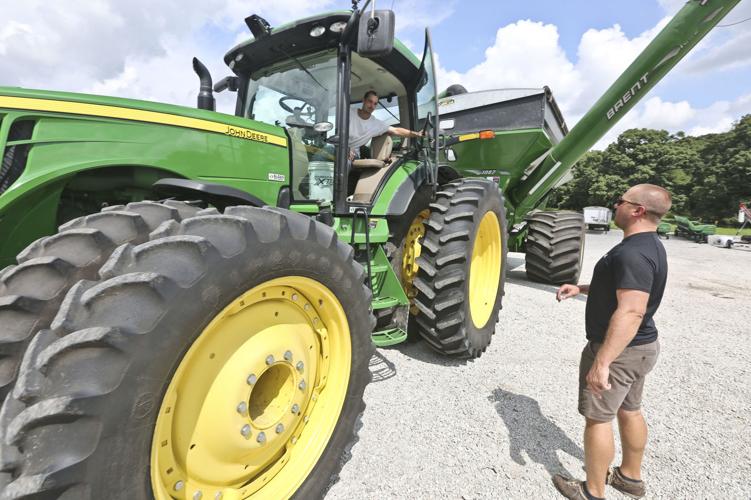
DECATUR — Despite advancements in technology and modern safety features, some farmers aren't making upgrades to equipment. The reasons vary from cost to a preference for older machines to the convenience factor.
"You have to be in the mindset that it’s really an investment," said Grant Noland, who farms about 6,000 acres around the Decatur area with his family.

- Allison Petty
- 7 min to read
Farmers and safety advocates are fighting on multiple fronts to reduce the casualties in one of America’s most dangerous industries. One of the most important battlegrounds may be the coffee shop.
Farmer buddies sharing stories are the key to spreading a message of safety, said Robert “Chip” Petrea, a specialist with the University of Illinois agriculture safety program.

- Allison Petty
BLUE MOUND — After he lost the use of his legs in a 1983 truck accident, R.D. Elder didn’t know how he could return to farming.
But his love of it persisted. “Agriculture is what I’ve always had an interest in,” he said. “Agriculture is my home.”

- Allison Petty
Farmers say one of the biggest safety issues they face is sharing the road with other vehicles, especially at harvest time.
Large equipment, such as tractors and combines, can travel as slowly as 25 mph or less. Drivers are sometimes unaware of the speed limitations or frustrated by them, tailgating or passing the equipment in a hurry.
Herald & Review Special Report: Safety on the small farm
While virtually every place of employment is getting safer, agriculture remains one of the most dangerous American industries. The Herald & Review's four-part series delves into the issue, and how farmers and safety experts are working to address it.
- Allison Petty
- 8 min to read
As a longtime farmer in the Wapella area, Randy Toohill knows all about how to be safe as he goes about his day. He also is aware how fast a normal chore can turn into a threat.
In some cases, it’s 29 seconds — how long it takes for someone to become engulfed in a grain bin and at risk of suffocating, according to experts.
- John Reidy
Few settings speak to the American way of life quite like the family farm, where children have long been expected to contribute to the collective well-being by learning with their hands the tools and skills of a trade that settled the prairie.
But despite the iconic status, small farms are also just that — farms, with serious dangers unique to any other business. The nature of farming means heavy machinery, blades and chemicals are part of life. And while virtually every American industry has undergone rapid changes in child labor rules over the past century, the small family farm — which are generally exempt from Occupational Safety and Health Administration regulations — are a unique holdout. Here, amid tractors and combines ramping up for this harvest season, boys and girls learn the family business, risks and all.
- Ryan Voyles
DECATUR — Despite advancements in technology and modern safety features, some farmers aren't making upgrades to equipment. The reasons vary from cost to a preference for older machines to the convenience factor.
"You have to be in the mindset that it’s really an investment," said Grant Noland, who farms about 6,000 acres around the Decatur area with his family.
- Allison Petty
- 7 min to read
Farmers and safety advocates are fighting on multiple fronts to reduce the casualties in one of America’s most dangerous industries. One of the most important battlegrounds may be the coffee shop.
Farmer buddies sharing stories are the key to spreading a message of safety, said Robert “Chip” Petrea, a specialist with the University of Illinois agriculture safety program.
- Allison Petty
BLUE MOUND — After he lost the use of his legs in a 1983 truck accident, R.D. Elder didn’t know how he could return to farming.
But his love of it persisted. “Agriculture is what I’ve always had an interest in,” he said. “Agriculture is my home.”
- Allison Petty
Farmers say one of the biggest safety issues they face is sharing the road with other vehicles, especially at harvest time.
Large equipment, such as tractors and combines, can travel as slowly as 25 mph or less. Drivers are sometimes unaware of the speed limitations or frustrated by them, tailgating or passing the equipment in a hurry.
Contact Tony Reid at (217) 421-7977. Follow him on Twitter: @TonyJReid
Be the first to know
Get local news delivered to your inbox!

Tony Reid
Macon County Courts Reporter
Get email notifications on {{subject}} daily!
{{description}}
Email notifications are only sent once a day, and only if there are new matching items.