


Hometown: Rural Blue Mound
Family: Married to Tina (Beckett), who I met in first grade. We have two sons, Grant (wife, Logan) and Blake.
Occupation: President and chief executive officer of the Association of Illinois Electric Cooperatives and weekend farmer.
Education: University of Illinois, bachelor of science in agriculture
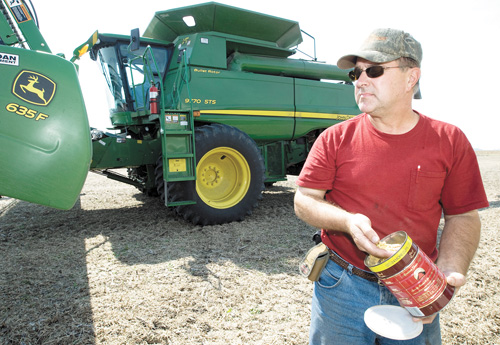
My “I’d rather be …” bumper sticker would read: “I’d rather be harvesting.” Central Illinois is blessed with beautiful and distinct seasons. As a farmer, fall means harvest and the reward for a year of effort. After 30 years, I still find harvest exciting and miraculous!
Hobbies/interests: I have a wide variety of interests, but no dominate hobby. I have always been a people person and enjoy all types of social settings with close friends and family or new acquaintances. Sports fascinate me, and I closely follow the Fighting Illini (and miss the Chief!), the Cardinals and Bears. Reading, travel and flying round out my spare time.
People are also reading…
My first job: Agribusiness officer at the Illinois National Bank in Springfield.
Personal approaches to challenges: I am a deliberative person when faced with challenges and never make snap decisions. I seek input and counsel from several sources, including my wife and family, and process that information. I also find comfort and strength in prayer and subscribe to the advice “sleep on it.”
Community involvement: My family is active in the First Christian Church of Decatur. Currently, I serve on the board of directors of Decatur Memorial Hospital and Millikin University, including the presidential search committee for the latter.
Agriculture organizations helped develop my leadership skills, so I share my time with several groups supporting agriculture. I chair the executive coalition for Illinois Agriculture in the Classroom and serve on the boards of the Macon County 4-H Foundation, Illinois Cooperative Council and America’s Heartland, a national public television show, promoting agriculture.
What have you been up to since leaving the Senate? My present position is a perfect fit for my skill set and background. I can use my understanding of rural issues, knowledge of government and experience as a former legislator to benefit the electric cooperative program. I would never have anticipated a job in association management, but I thoroughly enjoy my work. God does move in mysterious ways.
What do you miss most about being a legislator? People. After four terms in the Illinois House of Representatives and two terms in the Senate, the constituents in your district become your extended family. I miss the interaction with people and the ability to use government to improve lives and solve problems. We also miss hosting nearly 1,000 supporters on our farm every September for our annual pork chop fundraising dinner. You are welcome to stop by but the cupboard may be bare!
What do you miss least about being a legislator? Pancakes and parades. Throughout the winter and early spring, every fire department, country church and Masonic lodge in my 10 county district held a pancake and sausage breakfast. And I was obliged to attend, sometimes two or three on a Saturday. I can’t look at a pancake the same anymore. I love a parade but walking in 30-plus parades each year from May until October is too much of a good thing. My hat is off to the Shriners.
Do you have any desire to seek political office again? Not a week goes by that I am not asked this question, and I take it as a compliment. I thoroughly enjoyed serving in the legislature and count my time in office as a true blessing. My current position allows me to interact with members of the state legislature and Congress on issues and politics. Plus, serving on the Governor’s Ethics Reform Commission kept my hand in the game. But, I have learned, you never say never.
Any suggestions for your former colleagues about dealing with the financial mess the state finds itself in? As hard as it may be, please stop kicking the can down the road and say no. When I served with Gov. Jim Edgar, he became known as Governor No. That approach, plus a rising economy in the ’90s allowed us to pay off a backlog of past due bills and build a surplus.
What is the Association of Illinois Electric Cooperatives? Since 1942, the Association of Illinois Electric Cooperatives has been a statewide member cooperative that includes 25 electric distribution cooperatives, four generation and transmission cooperatives and eight telephone cooperatives.
The AIEC provides a variety of services including engineering services and rate studies, safety/training programs, legislative representation, member information and public relations, videography, printing, professional education training and youth education.
The challenges for the Illinois electric and telephone cooperatives have evolved and responsibilities have expanded over the years, but the AIEC’s purpose remains the same as it was at its inception: To assist members of the association in improving the quality of life in rural Illinois.
What is the biggest challenge facing the state’s electric cooperatives? Our biggest challenge is the same challenge we’ve struggled with for most of our history: politics. Today, we are faced with many factors that are increasing the cost of electricity, but the number one issue is how we will address the issue of climate change. As it stands now Congress has failed to find a fair, affordable and achievable solution ,and the EPA is moving forward with regulation of CO2, which all sides agree is not the best solution. We need a legislative solution, not regulation. Nearly 80 percent of the electricity produced in the Midwest is generated with coal. With increasing demand, rising rates, CO2 regulation on the horizon, transmission line overload and an economy that runs on energy already in the tank, we need to find the political will to craft an intelligent solution. We are working hard to educate our co-op member-owners and our elected representatives on this electricity crisis and the solutions we think will be effective.
What steps are being taken by cooperatives to develop more reliable, efficient systems? Illinois electric cooperatives maintain 56,626 miles of distribution and transmission line, and provide electric service in 90 Illinois counties. They serve just five accounts per mile of line, while investor-owned utilities serve 38 or more accounts per mile. This basic fact of low density means co-ops have always had to be incredibly efficient in order to keep rates affordable. New technology from automated smart meters to computers in line workers’ trucks is helping co-ops continue to work smarter and more efficiently.
In recent years we’ve seen several major ice and windstorms that have left devastating, long outages in their wake. Our co-ops have responded by increasing their vegetation management programs utilizing modern utility arborist standards, purchasing high-production clearing equipment and using new tools such as geographic information systems to do a better job of tracking the maintenance of the thousands of miles of right of way.
What significant changes do you see in the electricity distribution system in the next 15, 30 years? Electric co-ops are already taking the lead in moving toward what many are calling the smart grid. The majority of electric co-ops in Illinois have completed the installation of automated meter reading systems that will form the backbone of the coming smart grid. Other utilities in Illinois are just in the beginning stages of deploying smart meters.
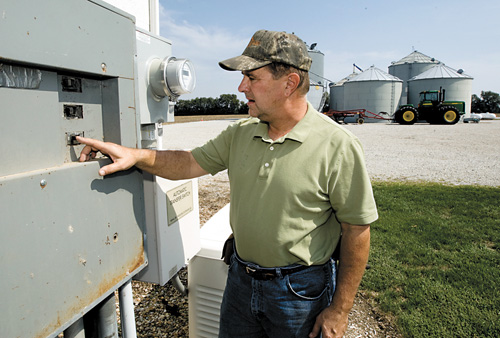
The co-op that serves my home and farm, Shelby Electric Cooperative, has already implemented an innovative smart grid solution using its smart meter network. I have a whole-house standby generator installed at my home that the co-op can utilize automatically using its smart meter network. When energy demand hits a peak, usually in the summer, my co-op can turn my generator on remotely. I don’t notice a thing. And for being on what is called an interruptible rate we save money each month on our bill. They also control other small generators across the system and together we all help reduce the system wide peak. Plus, my family has the security of a standby generator. This is being called a distributed generation network.
Some people are still struggling with the definition of the smart grid. Electric co-ops aren’t waiting for a definition. They are already defining it. I call that country common sense, and I predict we will see more of that kind of innovation in the next 15 to 30 years from Illinois electric cooperatives.


