


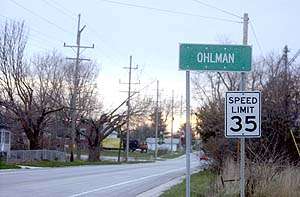
OHLMAN - An American flag flutters with the southwest wind, then drops as the breeze dies, alerting travelers on Illinois 16 between Pana and Nokomis to where the Ohlman post office stands on the south side of the road.
Surrounding the post office on the few adjacent streets are a cluster of homes, a church and some abandoned storefronts. A horse munches where students once played during recess as they attended classes. Across the highway to the north, there is a bank of elevators, another sprinkling of homes and the train tracks leading into and out of town.And the flag continues its ups and downs, almost symbolic evidence of what the village of Ohlman has been through in recent years since, according to the 2000 Census, it didn't officially exist.When those original Census figures were released, the official village population count was zero. The first Ohlman knew it didn't exist was when the population was published as zero in newspaper accounts of the Census.The ensuing years since have been spent working through governmental and bureaucratic red tape."When I first heard it, I thought it was some kind of joke," said village board Chairman Dennis Aumann. "So I called the Census Bureau."We had a gal go door to door. But what they can't tell me, what they can never answer for me, is where this count went.""It was quite a shock," said village clerk Mildred Pieper. "I'm still madder than a hornet about it."Where Is Everyone?But how did Ohlman "disappear" for three years?Simply put, according to Cathy Rhodes, who chairs the village recreation committee, "No one in town got a Census form."Rhodes feels some of the error was the Census Bureau's fault, some the community's.Apparently in 1998, the community was asked for both physical addresses and mailing addresses for its residents, as part of the participation in the Local Update of Census Addresses (LUCA). But only mailing addresses were put into the database, and in Ohlman, mailing addresses are post office boxes only. Without physical street addresses, no Census forms were mailed and, thus, no Census was taken.So the community began challenging its nonexistence. After nearly a year, the first official adjustment from Census officials brought the village up to 69 residents. More paperwork, more counting, more phone calls, and the next year, the official count went up to 75."Now $7,000 later, we might have this problem solved," Aumann said."In early spring 2003, we paid $7,000 for a special census. They went house to house and counted everybody in town," said Rhodes. And the official total, the village has been told, will most likely be 148 residents. "In 2000 when I counted, there were 177 people and 20 households," she said.Rhodes said Ohlman has received notice from the state that within two months, it should receive an official Census certification of the new count. That means the village should start receiving funds based on the 2003 count of residents.Lost FundingThe most obvious result of zero population was that state revenue that would have normally been Ohlman's - prorated on the basis of population - went initially to Coffeen, according to Rhodes."The main thing was our loss of money for the village," agreed Pieper who has held her post since the village incorporated in 1957.Information at the Illinois Department of Revenue's Web site states: "The amount (of income tax revenue) each municipality or county receives is based on its population in proportion to the total state population. The population figures are determined based on the latest Census conducted by the United States Bureau of the Census and certified by the Office of the Secretary of State."Illinois statutes provide for no adjustments to previous disbursements, which means there will be no recouping of lost money."I sympathize desperately with them (Ohlman residents)," said Montgomery County clerk Sandy Leithheiser, official keeper of Census data for the county. "But they are resilient."Other parts of the county had errors also, Leithheiser said. For example, she pointed out, "Irving was given too many residents."That was a relatively easy correction because it turned out that those incarcerated in a nearby prison were counted as village population."That has been corrected now," Leithheiser continued. "That was simple to fix. It would have been helpful if Ohlman's problem had been simple.""We lost about $40,000 to $45,000. It was taken out of our state revenue because of the Census count (of 2000)," said Rhodes. "This has caused a lot of problems for our community."Facing ChangesWithout the money coming in as planned, Ohlman residents faced changes.It's why the village hall project had to be halted when tax money wasn't coming in. The residents had been renovating the former United Methodist Church, which closed because of dwindling membership."We were doing something there every other month," explained Rhodes. "It (the loss of revenue) has made us cut back on children's as well as senior activities" that were part of a established recreation fund.Those activities include an Easter egg hunt, a wiener roast and ice cream sundae day, as well as Christmas fruit baskets for seniors, according to Mary Dirks, a longtime Ohlman resident.The community believes, Rhodes emphasized, that it's very important to have young people's activities, especially for those up to age 12.There was not enough money to provide snow removal or adequate street maintenance, both of which are funded from motor fuel taxes, which are also distributed on the basis of population.During the Census turmoil time, Ohlman was, however, able to secure a federal grant and take out a 40-year loan of $248,000 to install a sanitary sewer system. But the loan costs each household $29 per month, Rhodes added, a bill that would probably not be so high if the community had not lost the funds.Like many small communities, Ohlman residents have pitched in to continue to make things happen. They've done village cleanup days and, as Christmas neared, put decorations on utility poles and planned a community lighting contest. And they put together a cookbook whose sales have helped to continue to sponsor some youth and senior activities.Today, pretty much what's left in town is an elevator - now only open one day a week - a post office, an upholstery shop and trucking service and the United Church of Christ, according to Rhodes.Aumann remembers - he has lived in Ohlman pretty much all of his 52 years - a grocery store, two restaurants and a service station. "There never was a bar; this is a dry village."It's to that flag-bearing post office that most everyone comes daily. They find their mail in brass-doored mailboxes opened only by combination. It's from the post office that Postmaster Shirley State "walks the whole town at lunch," liking the feeling that she knows who lives in every house.Arlene Mannlein can be reached at 421-6976.


