

DECATUR – An old saying goes that there are four things you can't get back: The stone after it's thrown, the time after it's passed, the action after it's done, and the words after they're said.
But at Enterprise School, they have a method for repairing relationships even if you can't take back what you did or what you said to hurt someone.
Social worker Frances Godfrey uses a book, “Circle Forward,” in her work and she found the method in it and suggested to the staff that they use “community circles” with the students.
“Don't say you're sorry if you don't really mean it,” said sixth-grader Ashari Wilson. “You're not gonna mean it until you show it.”
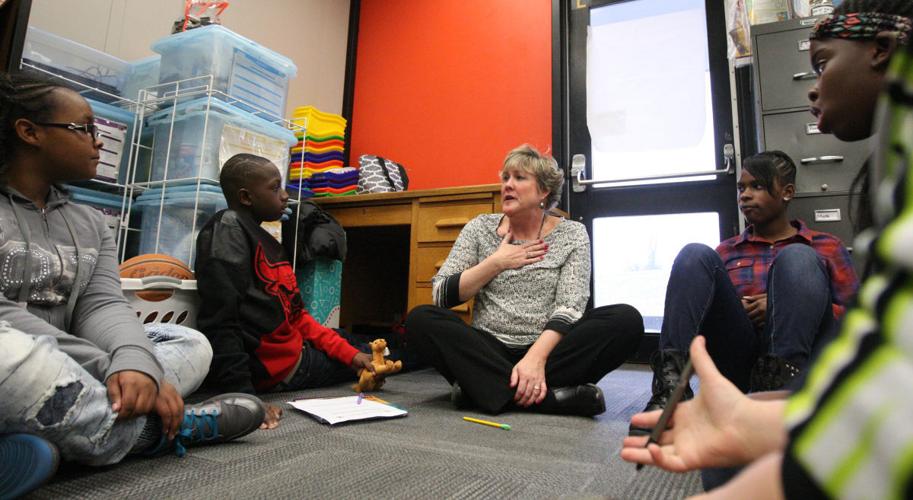
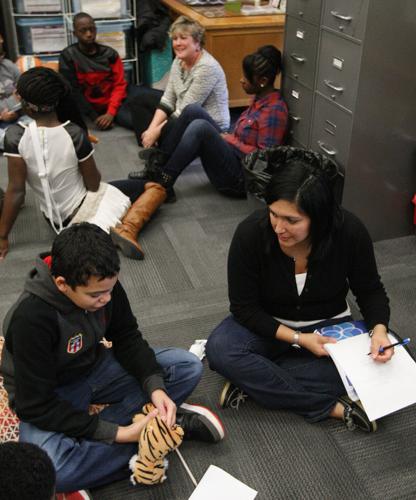
The way it works is, students sit in a circle, usually with a list of talking points, and a plush toy that is the “talking piece.” Whoever is holding that toy has the floor and the others have to be quiet and let that person talk.
People are also reading…
Sixth grade is home to a lot of drama, said student Malachi Brooks, and tempers flare and small disagreements and misunderstandings blow up into major issues. To illustrate, he teased the student seated next to him about his sneakers, calling them “leftovers from the 70s.” The other boy, knowing that Malachi was making a point, just laughed, but Malachi said such a remark could hurt someone's feelings, and things could escalate into a real problem from there.
“It's silly stuff,” Malachi said. “Someone finally gets enough and then,” he pretended to throw a punch, “it's on like Mike Tyson. Get it out playing Mortal Kombat or something. I don't know why people take their rage out on each other when they could take it out on something else like video games.”
Though the community circles are used at all grade levels, and even the staff uses them to clear the air over their own disagreements, the purpose of the circles is to give people a chance to calmly discuss and work out a break in their relationship to each other, whether that's a big or small break. One person has hurt the other's feelings, or has something difficult to talk about, and by agreeing to hear one another out, they can repair the situation and restore the relationship.
“I think it works,” said Za'Ryis Jenkins-Taylor, a sixth-grader.
Much of the drama, Godfrey said, comes of students talking about each other, and then it gets back to the person being talked over, and that person naturally resents it. She wants to teach the students how to be peacemakers, to confront problems and talk them over calmly, to make amends when they've hurt, to accept an apology if they're the one hurt, to think of others' feelings and learn to avoid hurting each other.
“What can you do to repair the harm?” she said. “What can we realistically do for each other to make it better?”
Principal Ann Mathieson said the staff began learning about community circles at the beginning of the school year, and introduced it to the children. Even the smallest students participate and learn to express their feelings. It's becoming a part of the school's culture, and kids come to the adults to ask for a circle when something is on their minds.
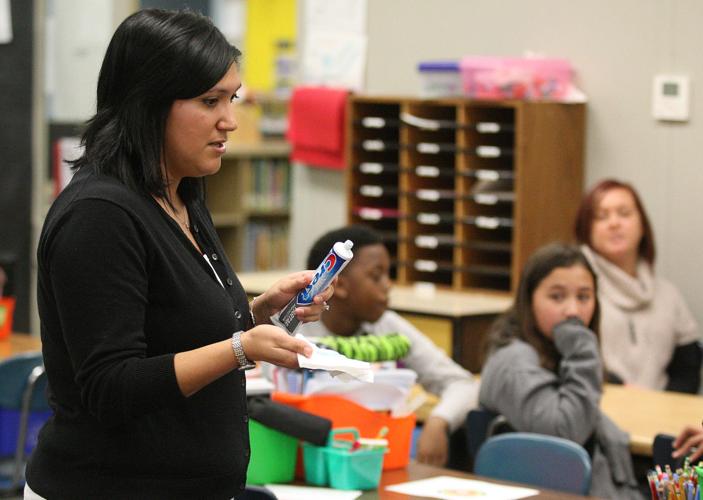
Godfrey used a favorite illustration to prove to the kids that they should weigh their words before they say them. She held a tube of toothpaste and squeezed some onto a paper towel.
“Our words,” she said, indicating the toothpaste. “Once we say them, can we take it back?”
The students said “no,” almost in unison.
“It's like getting toothpaste back in the tube,” she said. “Can I put this back in here?”
Again, students said, “no.” Godfrey tried squishing the paste back into the opening and of course, it didn't work.
“What I've done is, I've created a giant mess,” she said.
And the point of the circles, she said, is to clean up that mess, to repair the relationship, to apologize and mean it and show you mean it by your actions, and to try to avoid making new “messes.”