


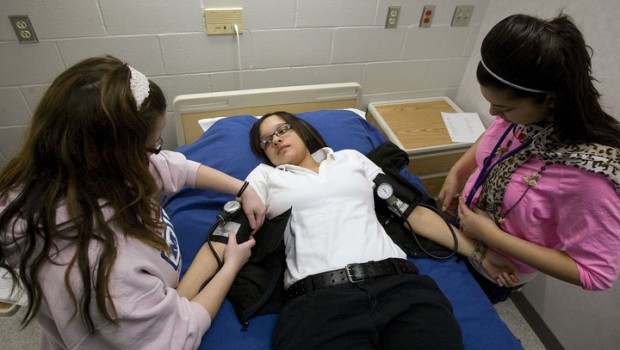
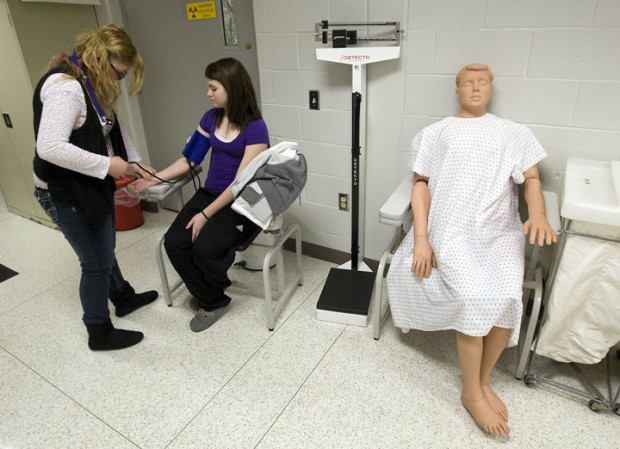
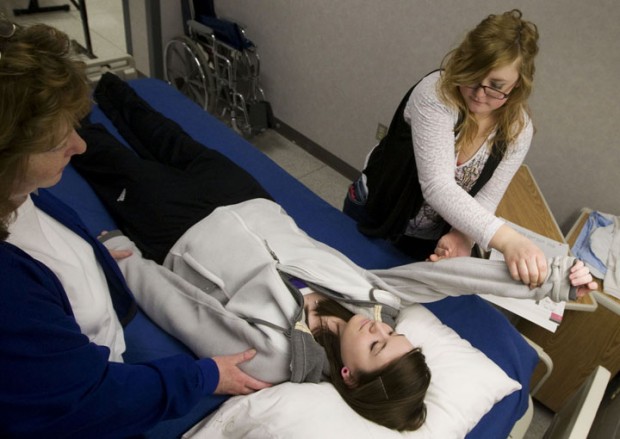
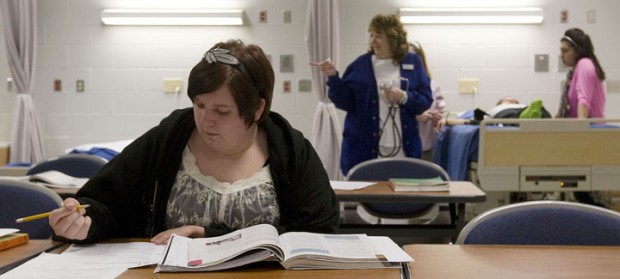
DECATUR — “OK, we’re looking at flexion and extension,” Heartland Technical Academy instructor Theresa McCormick said, addressing a small group of students in her secondary nursing assistant class at Richland Community College. “Which is which?”
“This is flexion,” said Taylor Uphoff, a senior at Okaw Valley High School, as she gently bent the arm of fellow classmate Carina Miller, a senior at Central A&M High School, as she lay in a hospital bed in one of the college’s health laboratories. “And this one’s extension,” she said, straightening Miller’s arm.
Taylor and Carina are just two of the many high school students taking dual-credit courses, or courses that provide students with both high school and college credit through Richland, and they said they’re thankful for the head start the classes are giving them.
“I want to go to (Southern Illinois University) Edwardsville for my RN (registered nurse) degree, and then I want to get a master’s degree in nurse anesthesia, and this is a jump start for me,” Taylor said of the nursing assistant class, adding that the clinical portion of the course, which involves working with patients at Imboden Creek Living Center, has been most helpful for her. “I didn’t know if I’d like working in a nursing home, but I’ve enjoyed it.”
People are also reading…
Daneisha Hardy, a senior at MacArthur High School who hopes to become a registered nurse and eventually a director of nursing at a hospital, said the dual-credit course has benefited her as well, giving her a lot of hands-on experience.
“This class gives you real experience, and it’s helped me decide the kind of nursing I want to do,” Daneisha said.
While many Illinois community colleges, including Richland, began offering dual-credit programs and courses in the 1970s and 1980s, college administrators say the programs really began to take off in the early 1990s and 2000s.
“At Richland, there are really two tracks when it comes to dual credit,” explained Tod Treat, vice president of student and academic services at Richland. “There’s the transfer track, which allows students who intend to eventually attend four-year universities to take classes here that will transfer smoothly to a university, and there’s the CTE (Career Technical Education) track, which helps students get certification for high-skills careers, like welding, engineering technology and certified nursing assistants.”
“Dual credit helps create a seamless education highway between secondary and post-secondary education,” said Lisa Gregory, executive director of public information and chief of staff at Richland, noting that while Mount Zion was one of the first high schools to partner with Richland for dual-credit courses, now every high school in the college’s district is participating. “It’s different from high school because it allows the students to be in a college environment, and that’s exciting for them.”
With nearly 1,648 dual-credit students in fiscal year 2011, compared to 1,022 in fiscal year 2007, dual credit continues to grow in popularity and has become a mainstay at Richland, not only allowing students to get a taste of what college is like, but also making college more affordable.
“Dual credit reduces college costs for parents, especially with increasing tuition costs,” said Doug Brauer, Richland’s vice president of economic development and innovative workforce solutions.
Early college courses and courses awarding dual high school and college credit also help students with specific career goals to get through school faster, said Dr. Hillarie Ryann Hudson, 28, an orthodontist at Hudson Orthodontics.
“From a young age, I always wanted to be an orthodontist,” said Dr. Ryann, whose father, Dr. J. Michael Hudson, is also an orthodontist. “My Dad told me that it would take about 10 years for me to go through school, and I knew I wanted to get married and have kids, so I asked him if I could start taking college courses early.”
Throughout her four years at Mount Zion High School, Ryann began taking dual-credit and regular college courses at Richland each summer, and by the time she graduated, she had more than 30 college credits under her belt.
“I graduated with my masters of science degree in dentistry in 2010, and I was 26,” she said. “It shaved two years off of college for me, and I would definitely recommend dual-credit courses for people who are focused and know what they want to do as far as their career.”
Carina echoed Ryann’s sentiments, noting that dual credit has helped give her more direction.
“I always knew I wanted to go into the medical field, and coming (to Richland and taking this class) made me realize I want to do it even more,” she said. “I want to be a labor and delivery nurse, and I know this will help me be a step ahead.”
nharbour@herald-review.com|421-7963


