


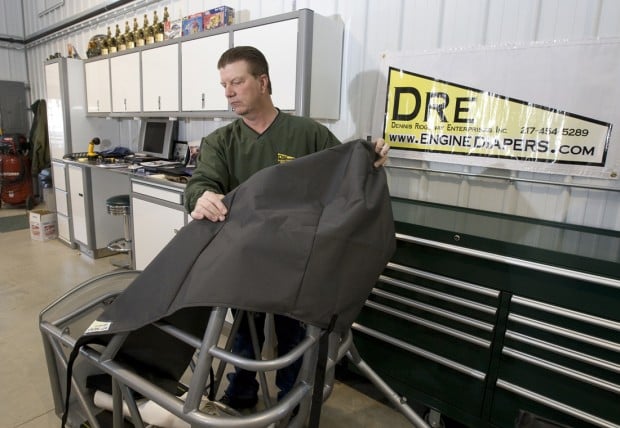
CERRO GORDO — He calls himself the diaper man, but he is not working for a company that retrieves smelly pieces of cloth from households.
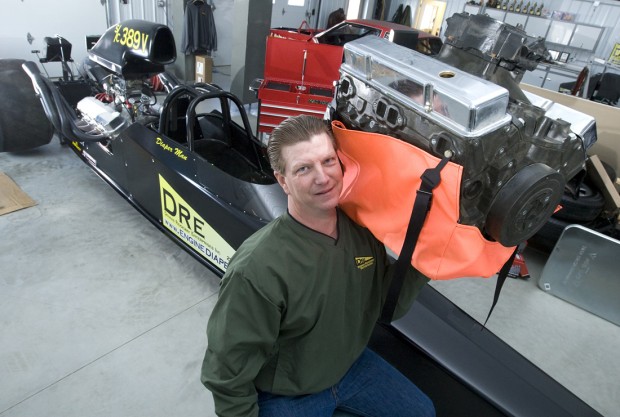
Dennis Ridgeway, 48, an entrepreneur and hot rod driver, cranks out hundreds of diapers that cover the undersides of race cars, to prevent them from messing up race tracks and killing their drivers.
“The main purpose of the diaper is to contain oil and parts if they blow an engine up,” Ridgeway said. “So the oil doesn’t get under their tires and cause the cars to crash.”
A Cerro Gordo High School graduate, Ridgeway has worked as a repairman and supervisor in the office machine industry, a boiler operator and a hunting guide.
He began drag racing about 15 years ago, and later noticed that the only diapers available were one-size-fits-all models.
People are also reading…
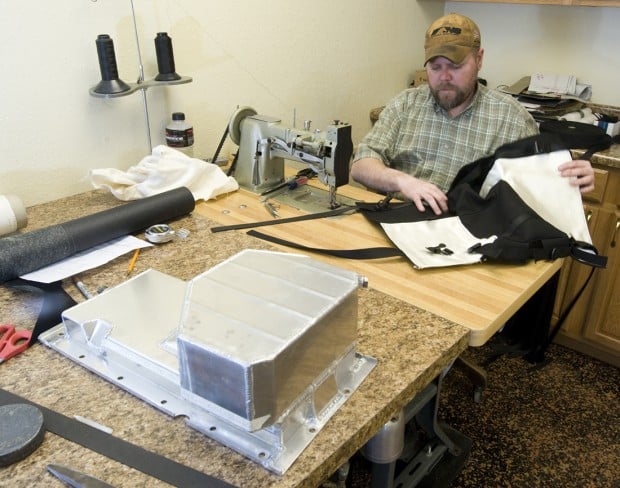
Anyone who has ever tried to cover a small baby bottom with an oversized diaper could see that this was an invention just waiting for a mother. Ridgeway, an accomplished auto mechanic, stepped forward. With the help of a friend, Tony Hyde, who has been working in the auto upholstery business, he began manufacturing engine diapers about four years ago.
His company, Dennis Ridgeway Enterprises, produces about 150 custom made engine diapers each year, in addition to several ready made models.
Engine diapers are used especially on drag racing cars, which take off like rockets for races on short tracks.
Diapers are mandated for cars running faster than 9.99 seconds in quarter-mile races (135 mph or faster), and 6.49 seconds in one-eighth mile races, Ridgeway said.
While diapers can also prevent huge messes on the tracks, necessitating large cleanup efforts, they are primarily used for safety.
“If a guy blows an engine at the finish line and he’s running 150 mph, the oil will blow out and hit his tires and could make it spin out and hit a wall or hit a competitor,” Ridgeway said.
An investment of $169 to $500 could save a $100,000 race car from being destroyed.
Ridgeway credits the success of his business to his devotion to old-fashioned customer service.
“We cater to the racers,” he said. “I spend a lot of time on the phone with these guys. I might spend three hours on the phone with a customer before a sale.”
Ridgeway, who recently constructed a 4,000-square-foot metal building in Cerro Gordo to house his business, said his venture allows him the freedom to race. While he is on the racing circuit, which includes Florida, Pennsylvania, North Carolina and Louisiana, he promotes his product.
The diapers are sold to race car drivers throughout the nation and internationally, with customers ordering from Sweden, South Africa and New Zealand.
The use of engine diapers is a growing trend in drag racing, said Mike Baker, senior director of competition for the International Hot Rod Association, a sanctioning body for professional drag racing.
“More facilities are requiring the use of diapers and engine containment devices,” Baker said.
The diaper provides an additional measure of safety for drivers, because engines do blow up.
“Without the diaper there could be smoke and oil everywhere,” Baker said.
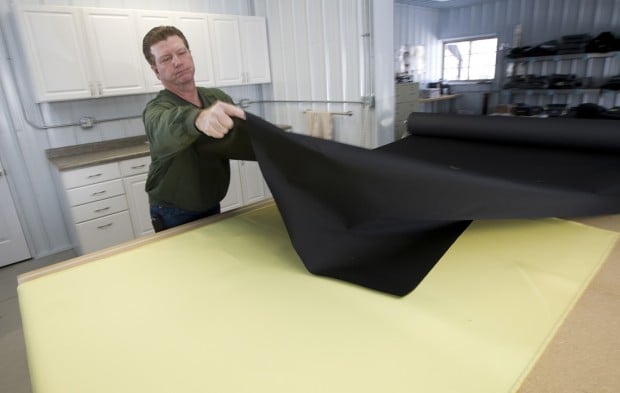
Ridgeway’s diapers feature a heat-resistant cloth, rated at 3,000 degrees Fahrenheit, which prevents them from melting. The cloth is reinforced with military strength Kevlar, to help prevent engine parts from penetrating and becoming unguided missiles.
Ridgeway’s 19-foot-7-inch long dragster, with a 605 cubic-inch, 1,100 horsepower engine, with a top speed of about 185 mph, has his nickname plastered across its side.
“Everybody calls me diaper man,” he said.
hfreeman@herald-review.com|421-6985


