


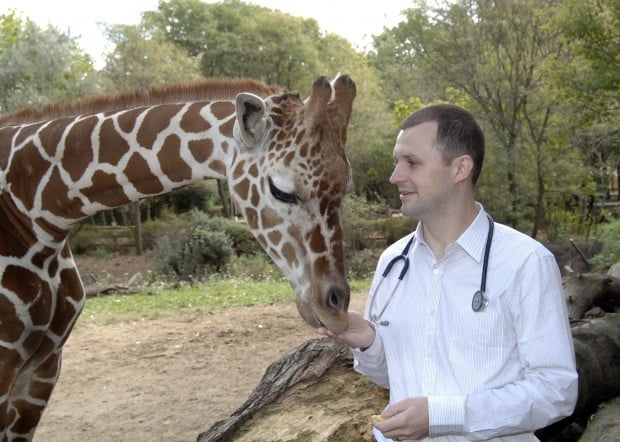
DECATUR — "I'm sorry I missed your call; I had to take a monkey to the hospital," said the former member of the Zoo Crew at Scovill Zoo.
Dr. Michael Adkesson, a Decatur native, was returning a phone call to talk about his career path which began with volunteering at Scovill. He’s now an associate veterinarian at Chicago Zoological Society/Brookfield Zoo.
“He was the kid that came to the zoo and wouldn’t go home. He’s still there,” said Mike Borders, retired director of Scovill.
“His mom would bring him early in the morning, pick him up late in the evening. He did the work of an adult, and he wasn’t even 12 years old,” recalled Borders. “Probably the youngest volunteer we ever had, he knew he wanted to make that his life’s work at a very young age.”
“I wanted to be a veterinarian and run a zoo,” Adkesson agreed, adding that he’s now doing the two things that early caught his passions.
People are also reading…
Borders played a “huge role in my life,” Adkesson said. “He hired me at (age) 15 to work at the Scovill Zoo and was always extremely supportive of my dreams.”
Adkesson is a 1997 graduate of Stephen Decatur High School, whose school years took him through Johns Hill Magnet School, where he remembers encouragement from Muriel Sumpter, Nola Wilkinson and Toni Nale. But he also got strong encouragement from his high school biology teacher, Carolynn DeVore, “who had a huge impact on me as a student, inspiring me to pursue my dreams of being a zoo vet and helping believe I could achieve that dream.”
Adkesson went through the University of Illinois, for undergraduate and veterinary studies. His residency took him to the St. Louis Zoo for a University of Missouri program.
“It was a great training program, wonderful people,” he recalled.
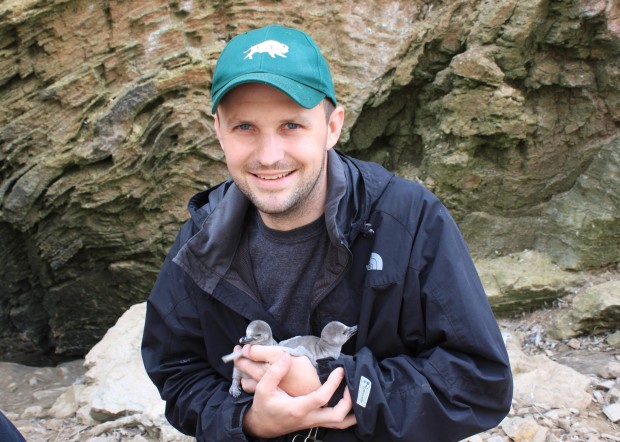
It was there that Adkesson began the program he now continues, doing health assessment of the Humboldt penguins in his field work at Punta San Juan, Peru, the penguins’ most important breeding site in that country.
That’s one of the things which speaks well of Adkesson’s energy, said Dr. Tom Meehan, vice president for veterinary services at the Chicago Zoological Society and Adkesson’s supervisor.
“He sort of single-handedly put together the aspect of the Humboldt health assessment, which he has continued here at Brookfield,” Meehan said, beginning while still in his residency.
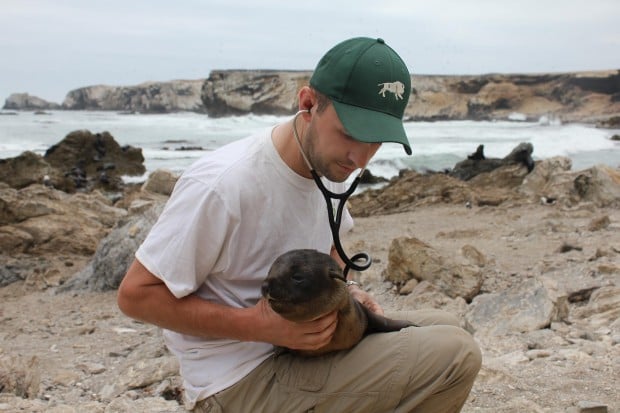
Adkesson said his work with the Humboldts is looking at environmental contaminants, toxicant exposure and what can be done to proactively protect the population. And his biannual visits have expanded to studying the South American fur seal, which makes its home there.
Adkesson finds this work different but complementary to what he does at Brookfield Zoo.
Being a zoo and wildlife medicine veterinarian, he said, is “not a standard 9-to-5 job, as much as we try. It’s hard to predict what animals are going to get sick. We try.”
Brookfield animals are on a preventive medicine schedule with routine checks, he explained. “There are certain differences between a tiger and a house cat, a hyena and a dog, but so much of basic medicine is the same.
“The specialty is using all of the knowledge,” Adkesson added.
“A giraffe is not that much different from a cow, but getting a blood sample is a huge challenge. You can’t throw a halter on a giraffe, the way you would a cow. It’s a big procedure.”
Zoo and wildlife medicine takes a little different mind set, Meehan said. “There’s a tremendous amount of information to try to get your head around. You have to know an awful lot about very many species.”
But these challenges also mean each day is different, Adkesson said. “We’re expected to know a whole lot about a whole lot of animals. The number of animals I deal with on a daily basis is extremely diverse.
“That was what hooked me as a kid. Every day was something kind of different.”
His advice for those wanting to become a zoo vet?
“The best advice I could give someone is to just believe in themselves and stick to their dream. There are a pretty limited number of jobs like mine available in this profession. I had a lot of people tell me how hard it would be to get a zoo medicine residency position and a job as a zoo vet.
“I’m a great example that if you are dedicated and work really hard, you will be successful.”
amannlein@herald-review.com|421-6976


