


PANA — In Shakespeare’s “Hamlet,” a gravedigger poses this question to another: “Who builds stronger than a mason, a shipwright, or a carpenter?” When the other gravedigger fails to answer, the questioner replies, “When you are ask’d this question next, say ‘a grave-maker’; the houses he makes lasts till doomsday.”
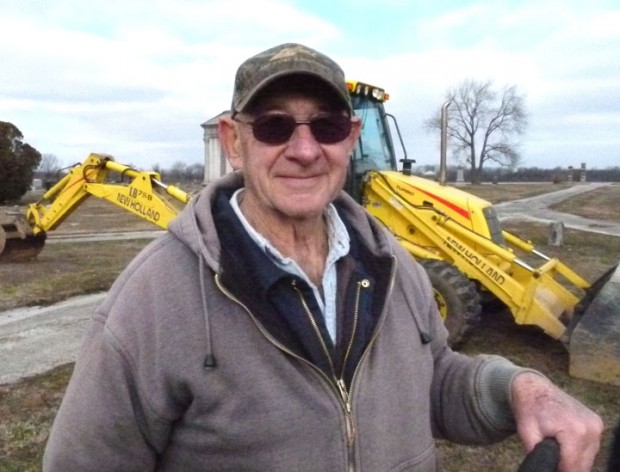
Stanley Elvers, who has been making graves for 40 years, would not argue with Shakespeare, except to remind him, if that were possible, that grave-digging is a lot easier with a backhoe than a pick and shovel.
His own career got off to slow start four decades ago, when a friend called and ask him to help him dig a grave.
“The old man had been digging graves around here by hand for most of his life, and when I showed up with my backhoe, he told me the machine was too big to be in the cemetery and sent me home,” Elvers said. “Two years later, he called me again, and this time, he welcomed the big machine. He was getting along in years and was looking forward to retirement, and I’ve been digging graves since.”
People are also reading…
The process starts with a phone call from a funeral director or a cemetery board member who provides him with a name and the cemetery where the deceased is to be buried, and quite often a lot number. Usually, Elvers finds a headstone, which makes his job a little easier. But it’s not always that simple. When there’s 2 feet of snow on the ground and no headstone, for example, the process takes on some aspects of a treasure hunt.
“More often than not, I have a pretty good idea where the lot might be, and with a snow blower and a little luck, I can usually find one of the corner markers, which allows me to find the others,” Elvers said. “A bigger problem is finding a lot in an older cemetery, where the corner markers were made of bricks laid on top of others. Over the years, many of them have been mashed into the ground by the mowing machines and are no longer visible. That’s when I may have to call the family to be sure we get the person buried in the right place.
Besides snow and water, cave-ins make Elvers life more interesting.
“I usually dig the grave the day before the service, which gives me extra time if a problem arises. In the case of water coming into the excavation, we simply pump it out. Elvers explained. “But when the sides cave-in, you have no choice but to keep digging until they can set the vault. It’s rare, but, because the ground was so unstable, I have had to set the vault out of sight during the service, and wait for the family to leave so I could set the casket aside and re-dig the grave. Then we reset the vault, lower the casket and the vault’s lid and fill in the hole.”
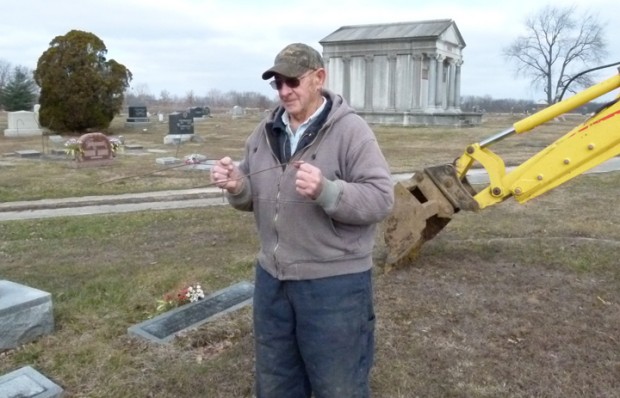
Not long ago, Elvers had to use his dowsing skills to locate the empty space in a line of occupied graves.
“I was able to find the empty grave site and put the deceased where he belonged,” Elvers said.
Tom Dean, who owns the McCracken-Dean Funeral Home in Pana, has worked with Elvers for nearly 25 years.
“I was pretty skeptical about the dowsing thing, so I took Stanley to a cemetery where I knew a man was buried with no head stone or other indicators. He started walking across the graves telling me whether the occupants were male or female and whether the person was an adult or a child. When he crossed the area that was unmarked, he paused and said, ‘There’s an adult male buried here.’ Since then, I have become less skeptical.”
Dean added that Elvers knows most of the cemeteries where his digs like the back of his hand.
“Stanley is very dependable and goes out of his way to help. He is on two cemetery boards that I know of and, since they have so little money, he does what he can to help them keep those cemeteries up. “
And like the houses of Shakespeare’s gravediggers, the graves that Elvers has created, will last till doomsday.


