


RURAL OAKLEY — Billy Walther and Dotty have been friends for more than three-fourths of his life.
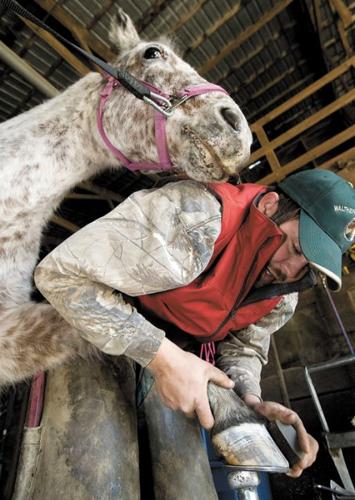
He knows that among her favorite treats are a bottle of Mountain Dew — “She’ll lift up the bottle and drink it,” said Walther. Soon to be 26, Dotty is a Pony of Americas with the spotted markings of the Appaloosa who still enjoys a good carrot, a crunchy apple, even an occasional hamburger and fresh hay.
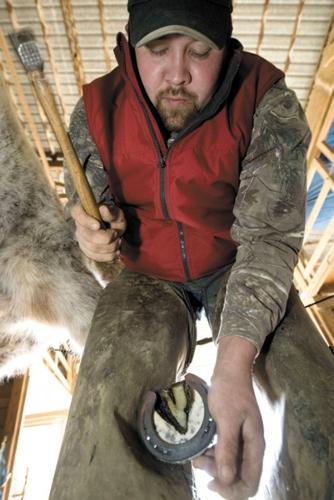
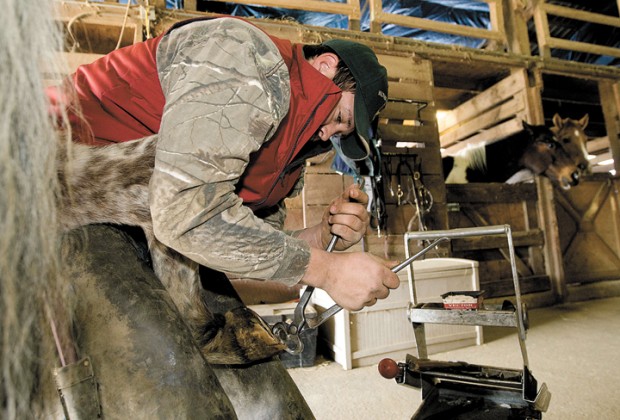
“She was always easy going; she did whatever I asked her,” said Walther, citing showing and English and western riding events in which they competed, trail riding, going to petting zoos for 4-H and FFA, even including standing perfectly still. Recently, she stood patiently while he lifted one foot, trimmed the hoof, then moved to the next, part of the process of Dotty getting two new front shoes as he readied her for spring.
“(The shoe),” he explained as he started working, “is to protect the bottom of her foot.”
People are also reading…
Without them, he continued, “It’s just like us walking barefoot.”
Walther is like many in the business of horseshoeing today. He makes horse calls.
“I go to the horses,” said Walther. “Now there are a lot of owners who don’t even own a trailer. They don’t really need to have one.”
So, he goes to the animal and owner, whether the horse is boarded or stabled at home.
“For us, it is the norm for farriers to come to Big Creek to work on horses,” said Rebecca Lloyd, manager of Big Creek Riding Center. “Many of our boarders rely on (us) to help in scheduling appointments and holding their horses while the work is being performed.”
Walther said Dotty goes shoeless in the winter months, allowing her feet to rest. And he only puts shoes on her front feet, primarily because those feet and legs support about 65 percent of her 900 pounds. And it’s not like Dotty doesn’t have choices. Walther either shoes in a basic shape of aluminum or steel and has been known to custom-make a horseshoe when it’s required.
“Economically, it’s more feasible to buy premade than to make my own,” he said.
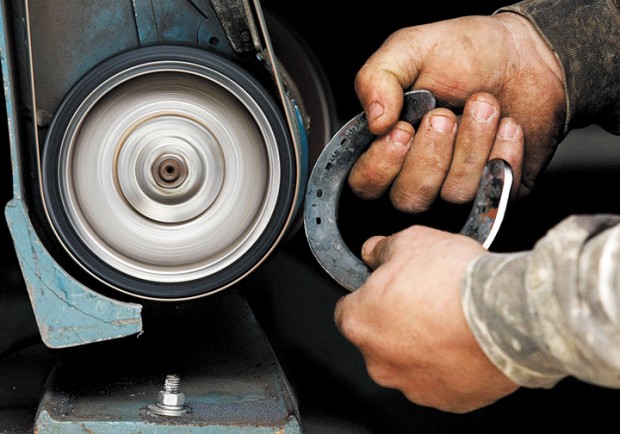
But whether custom or not, each shoe is molded to perfectly fit the horse’s hoof. “Each foot is a little different,” he added. Shaping and molding occur when he heats the steel via a propane-powered portable forge into a glowing piece of metal.
Pulling the red hot metal from the forge, he said, “Right now, they are about 1,600 degrees or so. At ‘black heat,’ they are still about 1,200 degrees.”
Lloyd said she feels each farrier has his own particular style and way of working. However, that being said, they all have the same common goal: to keep horses sound.
“Materials which are used for various shoes can also depend on the breed or discipline of riding that the horse is used for. Different materials of shoes can affect their weight which can also impact (positively and negatively) a horse’s way of going.”
Walther took up the profession after trying a couple of other options and because, at that point in time, there was a shortage of farriers where he lived. He went to a school in Colorado for about five months, then served as an apprentice farrier in Texas for another 10 months.
“We learned anatomy, general shoemaking. But you really don’t start learning until you are out in the field,” he said.
Walther is certified by the American Farrier Association, headquartered in Kentucky and founded in 1971. Being certified, said Lloyd, means that the farrier must keep up on current practices related to shoeing, as well as foot health.


