


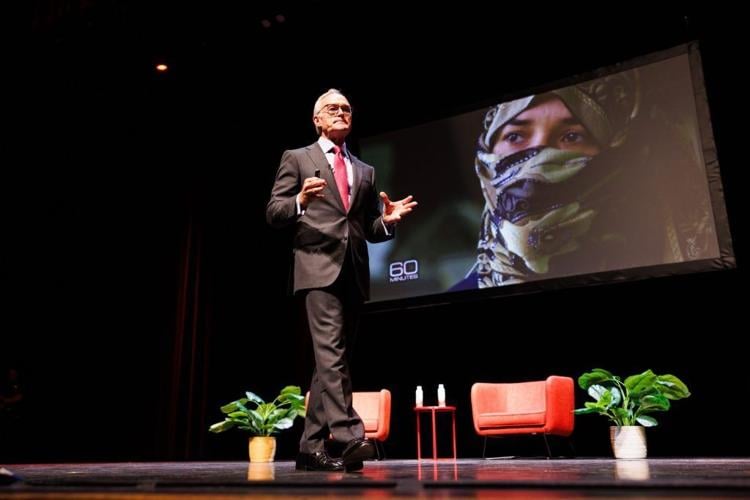
Amid the devastation of war zones and scenes of global events, award-winning broadcast journalist Scott Pelley has learned to identify the qualities of a true leader.
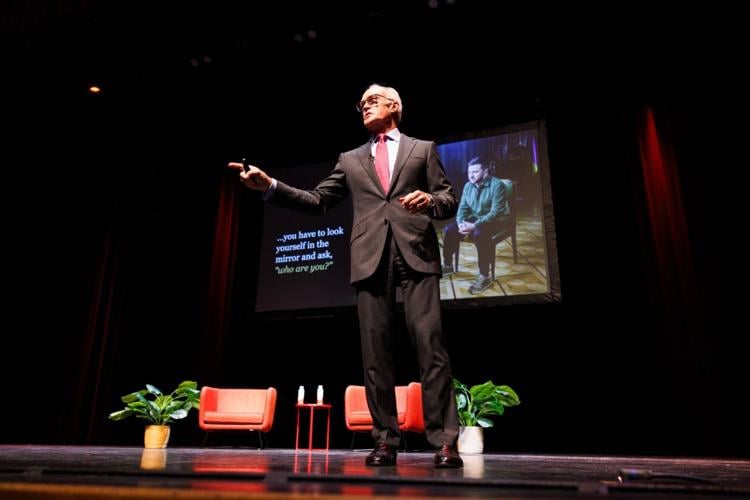
Pelley, former 60 Minutes correspondent, shared stories of courageous and empathetic people during his remarks at Illinois State University’s Presidential Speaker Series on Tuesday, October 27, before a crowd of 1,200 in Braden Auditorium.
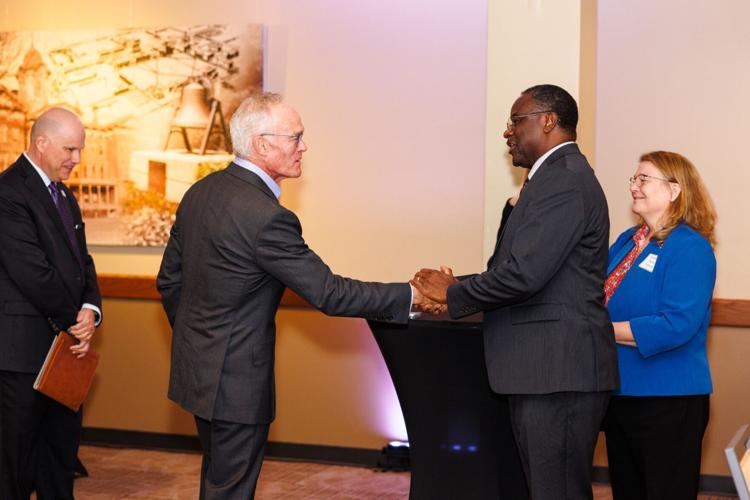
President Aondover Tarhule opened the event by explaining the purpose of the series: “Leadership in Times of Uncertainty.”
“At a time when the challenges facing our communities, our country, and our world are increasingly complex, it is important that we make space to listen, to ask questions, and to consider perspectives that may challenge our assumptions,” Dr. Tarhule said.
Pelley agreed that times are uncertain, but he said meeting with Illinois State journalism students ahead of the event filled him with hope.
People are also reading…
“If you doubt the country for a second, go to your nearest college or university campus. You’ll feel better immediately,” he said.
Throughout Pelley’s 50-year reporting career, three individuals stand out as true heroes. The first, he said, is Ukrainian President Volodymyr Zelenskyy.
As a CBS war correspondent, Pelley met with Zelenskyy several times in Ukraine following Russia’s invasion. He walked with Zelenskyy through the presidential palace in Kyiv, shining flashlights down passageways lined with sandbags and sleeping soldiers. He witnessed the atrocities of war, including a mass grave with 120 civilians killed by Russian forces.
During a 60 Minutes interview, Pelley asked Zelenskyy about the source of his determination. The former comedian turned war commander replied, “You have to look yourself in the mirror and ask, ‘Who are you?’”
“When the Russians came at him from three different directions, he discovered who he was,” Pelley said. “Those values rose up in him, and he discovered courage and perseverance.”
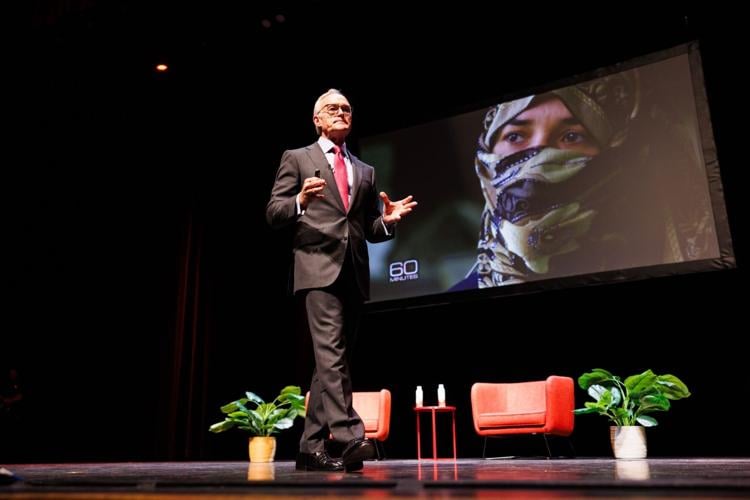
On an assignment in northern Iraq, Pelley was seeking a source to interview from a refugee camp. A woman, who saw much of her Yezidi community massacred and suffered abuse from ISIS terrorists, agreed to share her story anonymously. Sensing her discomfort as the interview began, Pelley offered to call it off. But she insisted, and he watched her courage swell.
“She started to gather some strength and determination,” Pelley said. “It finally occurred to me that in the beginning of the interview, she was speaking for herself. But by the middle of the interview, she was speaking for her people.”
He did not learn her name—Nadia Murad—until 2018, when she won the Nobel Peace Prize for her efforts to end the sexual violence that women and girls experience during war.
Pelley then recalled the morning of September 11, 2001, when he watched the towers fall and dropped to his knees along the Hudson River. Pelley picked himself up and joined colleagues at ground zero where they spent weeks covering search and recovery efforts.
He shared the story of New York City firefighter Orio Palmer, who died while trying to save hundreds of people trapped at the top of the south tower.
“We didn’t know about his heroism until 2005, when the FDNY released recordings of radio transmissions from inside the towers,” Pelley said.
Palmer, loaded with 50 pounds of gear, can be heard radioing instructions to firefighters below as he climbed to the 78th floor in a final act of bravery.
“Perseverance, courage, dedication—those are the things that animate true leaders in our world,” Pelley said.
“Empathy breeds character, and character breeds heroism.”
—Scott Pelley
Pelley concluded the event by answering questions from the audience. When asked if the purpose of the First Amendment is often misunderstood, Pelley said it is less of a right for news organizations than it is a right for the people.
“You have the right to freedom of the press. You have the right to an independent media that is not censored or surveilled by the government,” Pelley said. “There is no democracy without journalism.”
When asked for advice by an aspiring journalist, he said the greatest gift any writer—or leader—can have is empathy.
“With that, you develop the values of the people that I talked about this evening: Zelenskyy, Murad, Palmer. These were people who had those values in their hearts and may not have realized it until that moment when it was called for,” Pelley said. “Empathy breeds character, and character breeds heroism.”


